


Path working in its core is straightforward. It’s principally a play within the woods. However upon getting the fundamentals down, the enjoyable will transfer into getting good in more and more troublesome circumstances.
A pair years in the past, we gave you somewhat introduction to trails. Now that you just’ve had a while to place the following tips into apply and discovered to decelerate, watch your footing, convey water, and never be a menace to hikers, let’s step up the sport with some intermediate path working abilities. That is the the place you’ll begin having fun with and even trying ahead to technical trails and dangerous climate. You’ll study to run smoother and safer. Sooner when it is sensible. Extra assured when the path will get bizarre.
Written & edited by Pavlína Marek
Additionally, a fast promise; I’ll preserve the gear speak straightforward. Sure, gear will help, however after I say we’ll “enhance your path working recreation,” it largely means talent. Right here’s what we’ll be trying into on this article:
- Extra effectivity on climbs and descents so that you’re not cooked midway in
- Your type and the way it could make or break your run
- How one can learn the path so that you run with it, not towards it
- Higher footing and fewer stumbles, slips, and ankle moments
- Extra confidence, particularly downhill and on technical sections
We’ll additionally concentrate on mindset. Trails reward adaptability greater than good splits. Should you attempt to run trails like a road workout, trails will humble you actually quick. A few of these abilities may really feel troublesome at first, however as Coach Eric Orton as soon as mentioned, “Don’t confuse issue with failure.”
1. Enhance Your Type on Uneven Terrain
Street type is generally about regular rhythm and effectivity. You run together with your chest open and your arms swinging, and with every step precisely the identical because the one earlier than. As you might need already discovered for your self, path type is extra about steadiness and traction. Pace comes second.
Posture
Hold your physique tall, such as you’re gently being pulled up from the chest. Adapt a slight ahead lean from the ankles, particularly when going uphill. Hold your shoulders and jaw relaxed, and until you’re utilizing poles or handheld bottles, let your palms calm down too. On the downhill, preserve your legs barely bent always.
Eyes
You need your head up, not staring straight at your sneakers the entire run. Look in entrance of you and browse the terrain (extra on this later). And don’t neglect to search for and round you every time the path is smoother!
Arms
Path arms are a factor. Not dramatic and flailing just like the wings of a scared pigeon however a bit wider than whenever you’re working on the highway. Your elbows will naturally go wider when the path will get technical so you’ll be able to steadiness. Your arms ought to assist you to really feel lively and prepared for a problem however you shouldn’t flip into an inflatable tube man.
Ft
On descents particularly, keep away from overstriding. When your foot lands approach out in entrance, you brake. Braking means sliding, quad shredding, shin splints, and falls. Your ft ought to be fast and light-weight, such as you’re solely maintaining your physique within the air and gravity is doing all of the work of really shifting ahead for you. A buddy as soon as described good downhill working type like a superbly managed fall.
An excellent psychological cue is quiet ft. In case your footfalls sound heavy and slappy, you might be in all probability stomping, reaching, or braking. Quiet often means you might be touchdown beneath you with management.
In my humble opinion, that is the place the magic lies. I’m sluggish as heck and will by no means sustain with my working mates on roads or clean trails. However when the going will get technical, that’s when the hole shrinks. And as soon as we hit a troublesome, techy downhill, even my quickest buddy who ran a 50K in half my time can’t sustain. You might be solely reasonably match and nonetheless really feel quick and clean in case you do these two issues effectively.
Cease observing your sneakers
I’ve mentioned it earlier than and I’ll say it once more; whereas your sneakers could be fairly, they’re not the one factor you wish to see throughout your path run. relying on the technicality of the path and your pace
Whenever you’re working, scan the path 5 to fifteen ft forward relying on the technicality of the path and your pace. You’re searching for the final line, huge hazards, upcoming turns, and good foot placements. On the similar time, look forwards and backwards to do fast checks nearer to your ft for the precise placement within the subsequent step or two.
Should you solely look proper in entrance of you, you react late and also you stomp. Should you solely look far forward, you miss the sneaky root that ruins your day.
Study to learn the path
Trails aren’t simply “filth.” They’re playgrounds and dancefloors, stuffed with obstacles and textures. Don’t battle the path however learn it and comply with its path. Foot placement issues. Traction is a talent. Sneakers matter, certain, however how and the place you place your foot makes all of the distinction.
Additionally, decide the very best line, not the shortest line. The “straight line” usually goes proper by way of the worst rocks and roots. The nice line could be one step to the facet on smoother filth.
Hardpack
Presumably essentially the most forgiving and favourite floor of all of them. Hardpack filth remains to be smooth sufficient to be type to the joints however clean sufficient so you’ll be able to stretch your legs. You might be quick, constant, and you’ll open up your stride.
Unfastened gravel
Whereas nonetheless straightforward to run on, it may be unstable and roll underfoot, particularly whenever you’re working quick and wish to take a sharper flip or decelerate shortly. (Ask me how I do know; I had a chunk of gravel embedded in my thigh for about two years from taking a flip a bit too quick, and unintentionally doing a soccer-player-worthy slide.) You need barely shorter steps and secure landings.
Rocky, rooty, technical
Generally, your finest technique with these is to decide on the rocks. Search for secure, dry rocks and roots and land on the entrance of your ft. It is going to be extra of a dance than a run. Have enjoyable with it. Choose your approach as in case you had been working throughout a minefield, since you may lose your ankle actually shortly with a incorrect misstep.
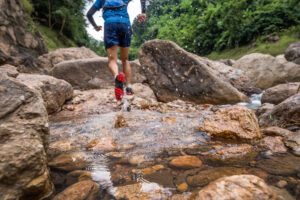
Moist roots and moist rocks
Keep away from stepping straight on them when you’ll be able to, they’re like nature’s animation banana peels. If it’s a must to step on them, land flatter, softer, and fewer on the sting of the shoe. Don’t push off aggressively and preserve steps fast and light-weight. Touchdown on the ball of your foot will provide you with the softest touchdown and most management.
Mud
Mud is the place overstriding will get severly punished. You’ll slip, do an involuntary cut up, and find yourself feeling and looking such as you’ve simply achieved a Powerful Mudder as a substitute of a path run. If it’s not slippy, it may be extremely sticky.
When working in mud, you’ll wish to shorten your stride (you may begin seeing a sample right here), settle for slower pace, and search for edges with grass or firmer filth if it’s secure and allowed. Nevertheless, don’t destroy the path to save lots of 5 seconds and comply with LNT practices. Should you’re requested to stay to the path, settle for the mud and preserve delicate environments secure!
Sand
Lose sand will suck all of your vitality out. As a result of it’s smooth, you don’t get any rebound and your achilles tendon, which often acts as a spring, will probably be largely ineffective. Until they’re moist and slippery, your better option will probably be to skip throughout rocks, even when it means uneven steps.
In sandy environments, take shorter steps and improve your cadence. Handle your effort, not tempo. Should you attempt to power highway tempo in sand, you’ll simply spike your coronary heart price and destroy your legs.
Off camber trails
Your ankles, knees, and hips will hate these. These trails really feel annoying as a result of they’re. Whether or not you’re working on a singletrack that has been weathered into the form of a “V” or on a service highway that’s tilted to hell and again, gravity will battle towards you and your joints.
On off camber trails, attempt to preserve your hips degree and shorten stride (sure, once more). Prioritize secure placements and adapt a “switchback” working model if doable. Generally, the very best transfer on these is to decelerate 5% and cease preventing it.
Stability comes first, pace is secondary. When selecting your path, you must have the ability to preserve flowing easily throughout the terrain, even when every step will probably be completely different. Once more, you must really feel such as you’re gliding above the terrain as a substitute of preventing in. Deal with gentle and quick steps. You aren’t attempting to stomp by way of. On clean sections, certain, open up. Earn your pace.
4. Climb Smarter: Pacing, Energy Mountain climbing, and When to Save Your Legs
At some point when working with my buddy who was a a lot better runner than me, I requested him easy methods to run as quick and so far as he did. He held me again then and mentioned, “You see that? That may be a hill. Professional tip: hike that s***.” Robust path runners hike too. They only do it on purpose.
Particularly throughout lengthy efforts, attempting to run each climb is a entice. You spike your coronary heart price, work a lot tougher with minimal payoff, after which pay for it for the subsequent hour. The path doesn’t care about your delight. It rewards persistence.
Effort-based pacing
- Simple: you’ll be able to speak in full sentences
- Regular: you’ll be able to speak however solely briefly sentences
- Laborious: you’ll be able to produce only some phrases at a time
- Too onerous: you’re doing that panicky respiration factor
Most climbs ought to really feel managed and regular, not too onerous, until you might be particularly doing a exercise. You shouldn’t end a climb pondering, “There’s no approach I can run once more on these legs!”
The identical buddy who taught me about hills additionally taught me to attempt to sing. If I can sing, even when it’s somewhat damaged and off-key, I’m going on the appropriate effort.
When to hike vs run
Generally, energy climbing is the very best factor you are able to do in your run. There comes a degree the place it’s sooner than working whereas saving you vitality.
- it’s steep sufficient that your type collapses when working
- traction is dangerous and also you’re slipping
- your coronary heart price spikes immediately
- you’re attempting to preserve legs for a long term or race
- fatigue is constructing and it’s essential to keep cardio
And keep in mind, climbing isn’t failure. Energy climbing is a weapon. Hold it tall, palms on thighs in order for you, brief steps, regular rhythm.
Micro objectives on climbs
Choose small targets. Run to the subsequent switchback. That tree. That rock. Then reassess. This retains you from doing an excessive amount of, too quick, after which paying for it.
5. Descend With Management; Pace Will Come With Confidence
The final lesson of immediately lies within the hills. Regardless of what you may suppose, downhills are the place folks acquire or lose essentially the most time. And the place most falls occur. So yeah, that is the talent to study and respect. We’ve already touched on a few of these rules; all of them apply extra on the downhills.
Physique place
You need a slight ahead lean together with your hips beneath you and barely bent knees. Hold a decrease heart of gravity. Don’t lean again and brake an excessive amount of. I do know, leaning again feels safer, however it’s not. It makes you overstride, destroy your quads, and lose traction. Touchdown on heels additionally takes away your potential to steadiness and react shortly when the terrain is completely different from what you anticipated or whenever you slip/step incorrect.
Braking administration
As an alternative of “cease then go,” intention for steady management. Select managed traces early, use switchbacks correctly, don’t minimize them, and keep away from sudden onerous braking steps (your knees and every little thing else will than you). Additionally, let your ankles be somewhat springy. Stiff ankles make every little thing really feel sketchier. (Talking of which, strengthen your ankles.)
Confidence development
Your first aim is smoothness, not pace. Should you can descend with quiet ft and relaxed respiration, pace will present up naturally.
See You Subsequent Time!
Having left you with some homework, that is the place we’ll cease for immediately. Go on the market, have some enjoyable, and apply these abilities! I’ll see you again quickly with a component two of this intro to intermediate path working!
Finish of line
No extra posts
