


Most runners can learn a tempo off their watch. Far fewer can really feel it.
That hole reveals up on race day. You head out on effort, the primary few miles really feel simple, and the watch says you’re 20 seconds a mile too quick.
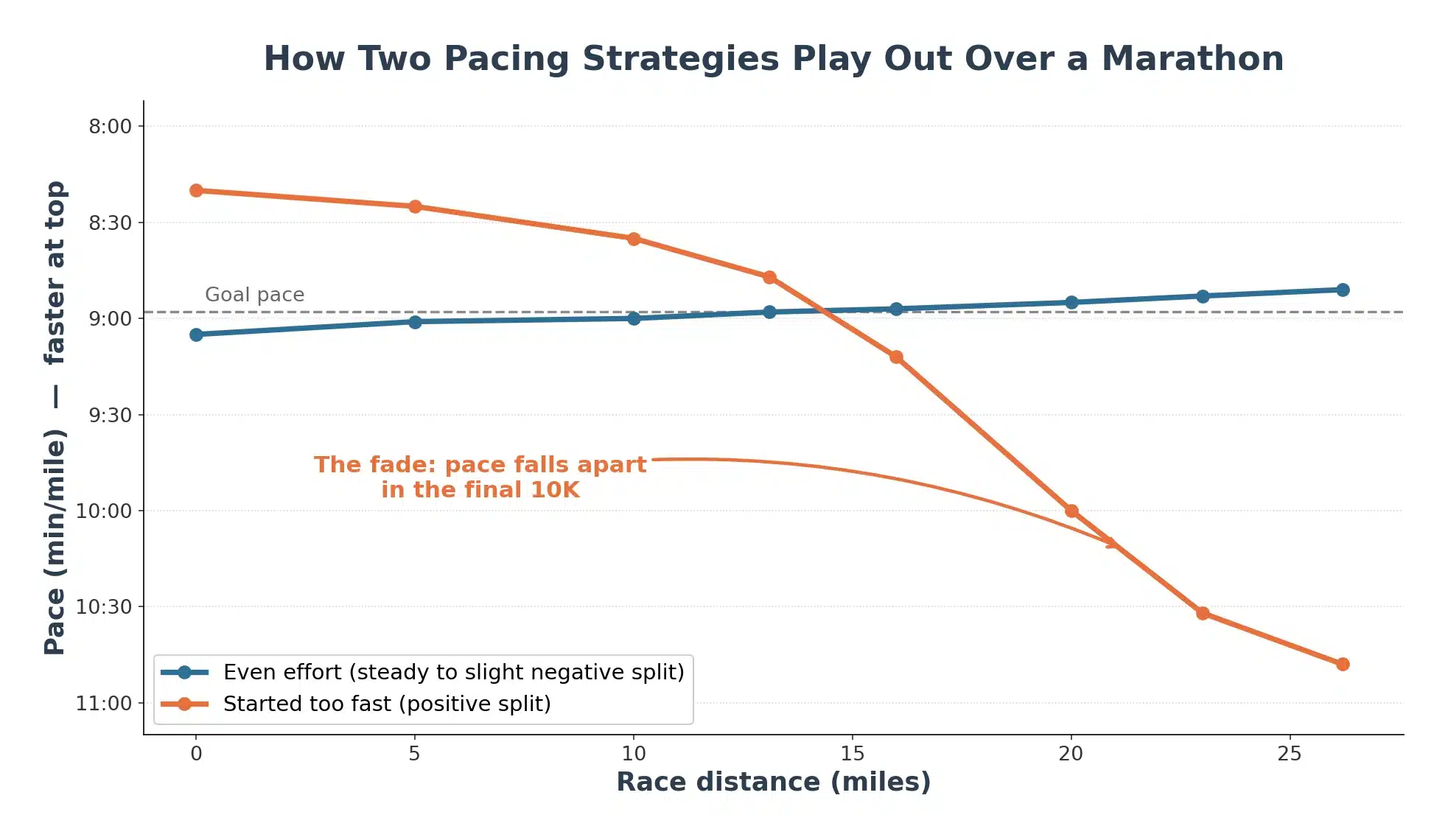
By mile 20, the time you banked early comes due.
Pacing by really feel is a trainable ability. Your physique fingers you effort, respiration, and rhythm cues on each run, and when you study to learn them you’ll be able to maintain a tempo with out staring on the display.
Right here’s what you’ll study:
- What a great jogging tempo really seems like
- The interior cues that inform you how laborious you’re working
- Tips on how to maintain a gradual tempo with out checking your watch each minute
- Tips on how to set a sensible objective race tempo and construct a plan round it
What Is a Good Jogging Tempo?
A great jogging tempo is one you’ll be able to maintain whereas speaking in full sentences. For many runners that lands between 10:00 and 12:00 per mile (6:13 and seven:27/km).
The quantity issues lower than the hassle behind it. On a scale of 1 to 10, a jog sits round 4 to six, the place your respiration stays relaxed.
Your actual tempo is determined by health. A 25:00 5K runner jogs round 11:00 to 12:00 per mile (6:50 to 7:27/km), whereas a 20:00 5K runner jogs nearer to 9:00 to 10:00 per mile (5:36 to six:13/km).
When you can’t communicate a full sentence at your jogging tempo, you’re working it too laborious.
That is the tempo for the majority of your weekly mileage. Run it by really feel and it stays simple on sizzling days, drained legs, and hilly routes, even when the quantity in your watch drifts.
How Do You Tempo Your self Whereas Operating?
You tempo your self by studying three inner cues: perceived effort, respiration price, and foot strike rhythm. Each tells you the way laborious you’re working and not using a look at your wrist.
Research has shown that perceived effort tracks coronary heart price intently, with the 2 shifting collectively at a correlation of 0.74 throughout 2,560 examined athletes.
Perceived effort is dependable as a result of it rises with the identical physiology your watch measures. Be taught to learn it and also you carry an correct pacing software on each run.
Perceived effort
Price each run on a 1 to 10 scale and log it. Straightforward runs sit at 4 to six, threshold work at 7 to eight, and laborious intervals at 9 to 10.
After a couple of weeks you’ll really feel a exercise’s demand earlier than you begin it. That preview is what enables you to settle into the best tempo from the primary mile.
Respiration price
Your breathing rate climbs with effort, so it doubles as a built-in tempo gauge.
Depend the steps you tackle every inhale and exhale. A 3-step inhale and 3-step exhale often indicators simple working, dropping towards 2 and a pair of because the tempo turns laborious.
Foot strike rhythm
Your cadence, the variety of steps you are taking per minute, rises as you pace up. Studying your rhythm at every effort provides you a 3rd method to verify tempo mid-run.
On a simple run your turnover feels mild and unhurried. At sooner paces the steps come faster and your foot meets the bottom with a sharper sound.
| Run kind | Effort (1-10) | Respiration | Discuss check |
|---|---|---|---|
| Straightforward / jog | 4-6 | Relaxed | Full sentences |
| Regular | 6-7 | Noticeable | Quick sentences |
| Threshold / tempo | 7-8 | Laborious however managed | A couple of phrases |
| Interval | 9-10 | Maximal | One phrase at a time |
How Do You Preserve a Regular, Constant Tempo?
You maintain a gradual tempo by main with effort and utilizing your watch to verify it. Runners who stare on the display chase each fluctuation and spend the entire run surging and braking.
Begin by guessing. Earlier than you look at a mile cut up, name out the tempo you suppose you simply ran, then verify.
The hole between your guess and the watch shrinks quick. Inside a couple of weeks most runners can identify their tempo inside 10 to fifteen seconds per mile.
Deal with your GPS as a second opinion on the hassle you already really feel.
Development runs practice this immediately. In a cutdown run you get faster because the run goes on, shifting by means of a number of paces you practice and race at.
Shifting gears on goal forces you to dial in a tempo by really feel again and again in a single session. That repetition builds a dependable inner tempo clock.
How Do You Discover Your Purpose Race Tempo?
Your objective race tempo comes out of your current coaching. Health you’ll be able to show in exercises is the one sincere enter.
Set your goal within the remaining 6 to eight weeks earlier than the race, then affirm it throughout the taper. A objective chosen 5 months out not often survives contact with actual coaching.
Don’t lock in a objective time till you’re inside 6 to eight weeks of race day.
A current race or a tough exercise at objective effort reveals you the tempo you’ll be able to really maintain. Feed a current end result right into a tempo calculator and it converts that health into coaching and race paces throughout distances.
RunnersConnect Bonus
Obtain your FREE Enchancment Efficiency Calculator now.
This helpful tempo calculator lets you decide what tempo you have to be working at in coaching and at every racing distance primarily based on a current race end result.
How Do You Construct a Race-Day Pacing Plan?
A race-day plan turns your objective tempo right into a mile-by-mile technique for the course, the climate, and your personal urge to start out quick. Three components determine whether or not you maintain the tempo or fade.
Alter for the course
Elevation adjustments what a end time prices you. A 3:55 marathon on a course with 3,000 ft of climbing calls for much more health than a 3:55 on a flat course like Berlin.
Examine the course profile and break it into segments. Spend slightly extra effort on the climbs and let the tempo come again to you on the descents.
Alter for the climate
Researchers found that marathon instances sluggish steadily as temperatures climb from 41 to 77°F, and the impact is largest for runners farther again within the discipline.

Warmth raises your effort at any given tempo, so a tempo that felt clean in coaching prices extra on a heat day.
Set a barely slower goal when the forecast climbs, retaining in thoughts that each runner has an optimal racing temperature.
Go away room to regulate
Even effort beats even tempo. Maintain your effort regular and let every mile land inside 5 to 10 seconds of goal quite than forcing an equivalent cut up.
Beginning too quick is the expensive mistake. An analysis of more than 300 marathoners discovered the runners who slowed most within the second half had been the youthful, much less skilled ones who went out too laborious.
Pacing by really feel begins in your simple runs. Guess your tempo earlier than you look, verify it towards the watch, and shut the hole week by week.
Try this persistently and by race day you’ll tempo off effort first, with the watch there to verify what your physique already is aware of.
