You’re midway by way of a run when the decrease a part of your calf begins to tighten.
As a substitute of loosening up as you heat up, it will get worse with each stride till you’re pressured to stroll dwelling.
Or it occurs all of sudden, with a pointy pop behind your leg throughout a exercise or a hill.
Both means, you’ve strained one of many 3 muscle tissue that make up your calf.
The irritating half is how usually a calf pressure comes again when you suppose it has healed.
So, how do you deal with it correctly the primary time and hold it from returning?
That’s what the analysis under covers, together with:
- The right way to inform which calf muscle you strained, and whether or not it’s a pressure or simply sore calves
- Why runners pressure their calves within the first place
- When to begin rehab, and the heel elevate take a look at that tells you you’re able to run once more
- Why calf strains hold coming again and what stops the cycle
Which of the three Calf Muscle tissues Did You Pressure?
Your calf is made up of three muscle tissue that each one connect to your Achilles tendon.
The two heads of the gastrocnemius kind the bulge you’ll be able to see on the prime of your calf, they usually cross each your knee and your ankle.
The soleus sits beneath them, runs decrease down the leg, and crosses solely your ankle.
As a result of solely the gastrocnemius crosses the knee, you’ll be able to inform the two aside at dwelling by altering your knee angle.
A sports medicine review on calf injuries explains {that a} straight-knee calf stretch hundreds the gastrocnemius.
Bending the knee takes the gastrocnemius out of the stretch and places the load on the soleus.
So in case your calf hurts extra in a straight-knee stretch, you’ve most probably strained the gastrocnemius.
If it hurts extra along with your knee bent, or the ache sits low within the calf close to the Achilles, you’ve most probably strained the soleus.
Gastrocnemius strains normally occur abruptly, usually with a pop throughout a quick push-off or a hill dash.
Soleus strains normally construct step by step, which is why runners so usually describe decrease calf ache that will get worse the longer they run.
In a study of 184 calf strains, 84.6% concerned the soleus, and strains that occurred whereas working took about 12 days longer to heal than strains from different actions.

Meaning the deep, low calf pressure is the one runners ought to anticipate, and it wants about 12 extra days of endurance than you would possibly plan for.
Is It a Calf Pressure or Simply Sore Calves After Operating?
Regular muscle soreness and a pressure really feel comparable at first, however they behave in another way when you begin shifting.
Soreness after a brand new hill session, a pace exercise or a race normally exhibits up the following day in each calves.
The entire muscle feels stiff, and that stiffness eases after 5 to 10 minutes of simple jogging.
A pressure normally sits in a single leg and one spot you’ll be able to press on.
It usually begins throughout the run as an alternative of the day after, and it will get worse the longer you retain going.
In case your calf ache will get worse as you run as an alternative of easing, cease and deal with it as a pressure.
See a physician in the event you felt a pop and might’t stroll usually, if the calf is badly bruised, or if it’s swollen, heat and purple with none clear damage.
Swelling and heat within the calf with no damage could be a signal of a blood clot, which must be checked the identical day.
Why Do Runners Pressure Their Calves?
Each working stride relies on your calves to carry you up.
A 2012 study that modeled the leg muscles discovered the soleus and gastrocnemius did many of the work of holding you up at each pace in need of a dash.
Meaning each stride on a simple run hundreds the calf, and a future provides hundreds of these strides.
So in case your calf isn’t sturdy sufficient in your weekly mileage, a sudden bounce in hills or pace can push it previous what it might probably deal with.
Switching to lower-drop sneakers does the identical, as a result of a decrease heel stretches and hundreds the calf extra on each stride.
Past coaching load, 2 components predict who will get damage.
A systematic review of calf strain risk factors discovered that getting older and having strained your calf earlier than had been the strongest predictors of a future calf pressure.
Peak, weight, intercourse and which leg was dominant confirmed no clear hyperlink.
The perfect predictor of your subsequent calf pressure is the final one you had.
Age is the rationale calf strains are so widespread in masters runners, and you may learn extra about why calf injuries become more common with age right here.
You possibly can’t change your age or your damage historical past, however each let you know to deal with calf energy as a daily a part of your coaching.
Ought to You Relaxation a Calf Pressure or Begin Rehab Proper Away?
Mild loading ought to begin inside a couple of days, lengthy earlier than the calf feels regular.
The previous recommendation was to relaxation a strained muscle till the ache was gone, and researchers have examined that towards beginning early.
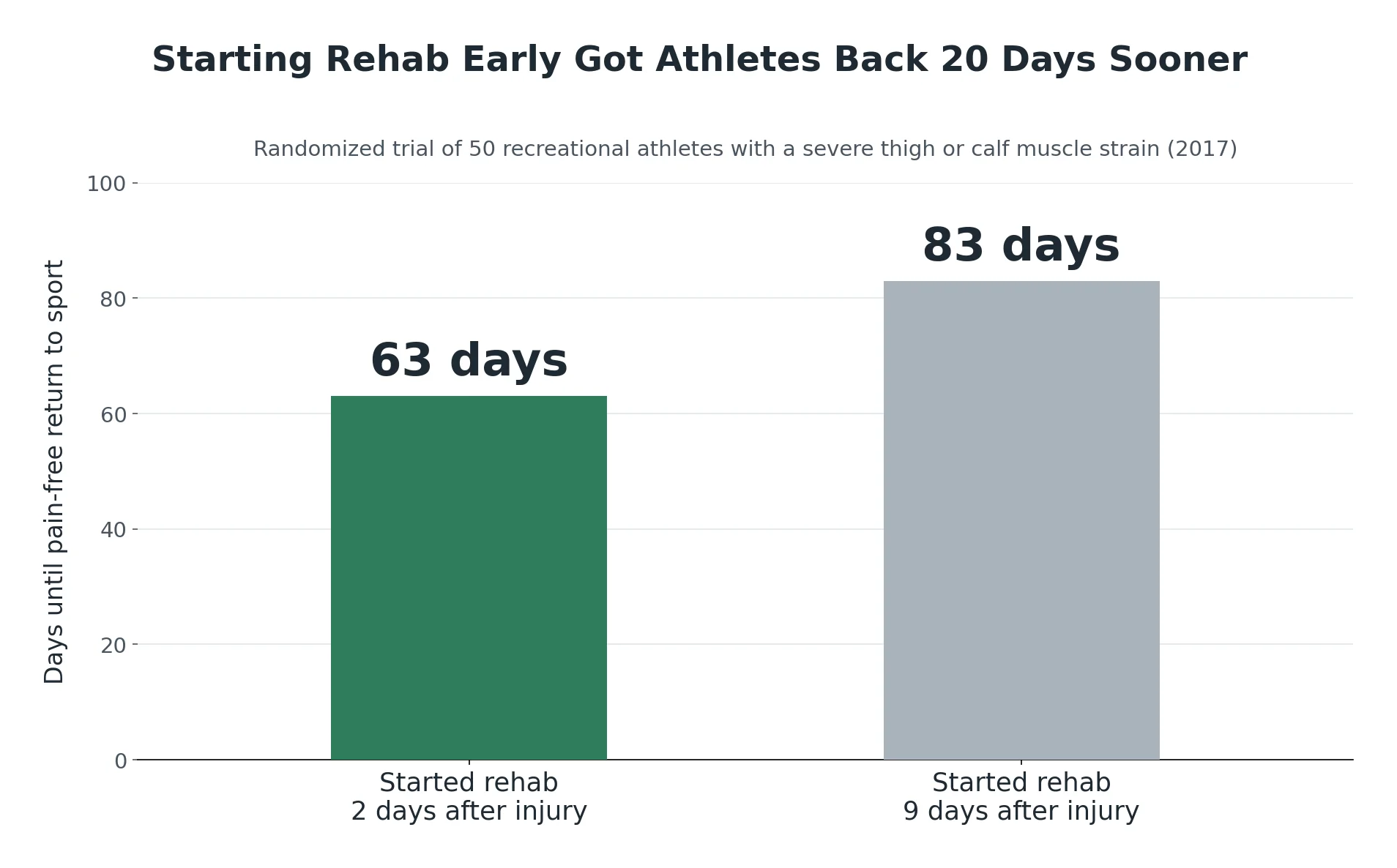
In a randomized trial, athletes who began rehab 2 days after a thigh or calf pressure returned to sport in 63 days, in contrast with 83 days for athletes who waited 9 days to begin.
Meaning every week of additional relaxation value these athletes about 3 weeks of additional outing.
The early group began with mild stretching and holds, then moved on to resistance work because the ache allowed.
Ache is your information for every step, and delicate discomfort that settles inside 24 hours is okay.
Ache that makes you limp, or that’s worse the following morning, means you moved up too quick.
Right here’s a development that follows the identical thought:
- Isometric heel elevate holds. Rise onto each toes and maintain for 30 to 45 seconds, 4 to five occasions, as quickly as you’ll be able to stroll with out limping.
- Double-leg heel raises. Do 3 units of 15 sluggish reps along with your knees straight and three units of 15 reps along with your knees bent, so that you load each the gastrocnemius and the soleus.
- Single-leg heel raises. Transfer to 1 leg as soon as double-leg raises are ache free, once more with each straight and bent knees.
- Eccentric heel drops. Stand on a step, stand up on each ft, then decrease slowly on the injured leg for 3 units of 15 reps.
- Loaded and quick work. Add weight to your single-leg raises, then add mild hopping in place earlier than you come back to working.
For extra workouts when you’re again to working, see these calf and Achilles strengthening exercises.
RunnersConnect Insider Bonus
Obtain our free Calf Pressure Harm Prevention Routine!
It’s a PDF with photos and descriptions of the best prevention and rehab workouts for runners that suffer from calf strains.
When Can You Run Once more After a Calf Pressure?
You’re able to run when your injured calf can do virtually as many single-leg heel raises as your wholesome one.
Till then, hold your health with biking, swimming or pool working, so long as they don’t carry on calf ache.
Cross Coaching Whereas Injured and Throughout Restoration
Aqua jogging is a type of deep water working that intently mimics the precise working motion. Your ft don’t truly contact the underside of the pool, so it’s zero impression and protected for nearly any sort of damage. In my expertise, the one time to keep away from aqua jogging is when you’ve gotten a hip flexor damage, which will be aggravated by the elevated resistance of the water as you carry your leg up.
As a result of aqua jogging intently mimics pure working kind, it supplies a neuromuscular exercise that, along with cardio advantages, helps hold the working particular muscle tissue energetic. The identical can’t be stated for biking and swimming.
The one draw back to aqua jogging is that you just want a pool that’s deep sufficient to run in with out touching the underside. When you’re fortunate sufficient to have entry to a pool of this measurement, aqua jogging needs to be your first cross coaching alternative.
Aqua Jogging Exercises For Runners
When you’re concerned with aqua jogging to rehab your damage, then the best possible means is to make use of considered one of my favourite packages, Fluid Running.
Medium Effort Exercises
Onerous Exercises
To check your calf, stand on one leg and do sluggish heel raises till you’ll be able to’t do one other, then repeat on the opposite leg.
In a study of 566 healthy adults, males managed a median of 24 single-leg heel raises and girls managed a median of 21 heel raises.
That offers you a goal if each of your calves are weak, however the quantity that issues most is your wholesome leg.
Earlier than your first run, it’s best to be capable of stroll briskly and hop on the injured leg with out ache.
Then hold the primary 2 weeks of working simple and flat.
Speedwork, steep hills and lower-drop sneakers all put additional load on the calf, so add them again separately as soon as simple runs really feel regular.
Why Does a Calf Pressure Hold Coming Again?
A calf pressure comes again most frequently while you return to full coaching earlier than the muscle has totally recovered.
A study of 149 calf strains in pro Australian football players discovered {that a} earlier calf pressure made a repeat damage inside 2 seasons 6.7 occasions extra probably.
Across 10 years of calf strains, 20% of repeat accidents occurred earlier than the athlete had totally recovered from the primary one, and people took a median of 46.7 days to return from.
Meaning dashing the final week of rehab can flip a roughly 3-week damage into an almost 7-week one.
Recurring calf strains normally come from 3 gaps which are simple to shut:
- Stopping rehab when the ache goes away. Hold doing single-leg heel raises till each legs match, after which twice every week for good.
- Including pace and hills too quickly. Give your self not less than 2 weeks of pain-free simple working earlier than you add both one.
- Altering sneakers throughout your comeback. Follow the heel drop you had been in earlier than the damage till you’re totally again to regular coaching.
In case your calf pressure retains coming again after you’ve closed all 3 gaps, see a bodily therapist who can test your energy and working kind.
Right here’s a fast recap of how one can transfer by way of restoration:
| Stage | What to do | Transfer on when |
|---|---|---|
| First 2 days | Stroll usually in the event you can, cross practice if it’s ache free | You possibly can stroll with out limping |
| Early rehab | Heel elevate holds, then double-leg heel raises | Double-leg raises trigger no ache the following morning |
| Power rehab | Single-leg and eccentric heel raises, straight and bent knee | Your injured calf practically matches your wholesome one |
| Return to working | Simple, flat runs for two weeks | Simple runs really feel regular throughout and after |
| Full coaching | Add pace, hills and lengthy runs separately | Hold heel raises twice every week for good |