


You end your weekend future, step within the door, and catch your reflection within the mirror.
Your face is puffy, your arms are bloated, and you are feeling heavier than once you left.
Your first intuition is to surprise if one thing went mistaken along with your hydration.
The physiological actuality is extra reassuring: your swelling is proof that your cardiovascular system is doing precisely what it’s designed to do throughout sustained train.
So, on this article you’re going to be taught the research-backed sensible recommendation on:
- Why your physique intentionally redirects blood to your pores and skin throughout runs
- How vasodilation and gravity work collectively to puff up your face and arms
- What’s occurring to your physique’s fluids throughout long-distance runs
- When swelling crosses the road from regular adaptation to a warning signal
- Learn how to decrease extreme swelling with out overhydrating
Why Does Your Physique Redirect Blood Throughout a Run?
Whenever you begin operating, your muscle tissues demand oxygen and gas.
Your cardiovascular system responds by shifting blood away out of your organs and towards your working legs and arms.
Blood can also be being concurrently routed to your pores and skin, and this second shift is what drives the swelling you see afterward.
Research has shown that thermoregulatory vasodilation can improve pores and skin blood circulation to six to eight L/min throughout intense warmth stress.
This occurs as a result of your core physique temperature is rising, and your nervous system prompts a thermoregulatory response to chill you down.
Your sympathetic nervous system opens the blood vessels in your pores and skin, a course of known as vasodilation, to dump warmth into the encircling air and thru sweat evaporation.
This energetic vasodilation accounts for 80 to 90 % of the pores and skin blood circulation improve you expertise throughout train, particularly in warmth.
Warmth dissipation is non-negotiable throughout sustained effort, and your physique prioritizes it as aggressively because it prioritizes transferring your legs ahead.
Why Your Face Swells Particularly Throughout Runs
Your pores and skin blood vessels are vasodilating all over the place throughout your arms, legs, torso, and face.
The rationale your face swells extra noticeably than different areas comes down to 2 converging elements.
Your face has an exceptionally excessive density of small blood vessels devoted to thermoregulation.
These facial vessels reply aggressively to temperature alerts, flushing with blood to radiate warmth from the pores and skin floor.
Concurrently, gravity is pulling blood downward into no matter tissues are lowest.
Whenever you’re operating along with your arms at your sides, gravity is working straight in opposition to your face and arms.
When blood vessels dilate beneath strain, the elevated hydrostatic strain contained in the capillaries forces fluid out of the vessel and into the encircling tissue areas.
This course of, known as capillary filtration, occurs throughout a whole bunch of small facial capillaries concurrently, pooling fluid in your cheeks, beneath your eyes, and in your lips.
A landmark study of ultra-distance cyclists found that 54.2% of athletes skilled swelling of the face and eyelids in the course of the occasion, with symptom onset at round 3 days into steady effort.
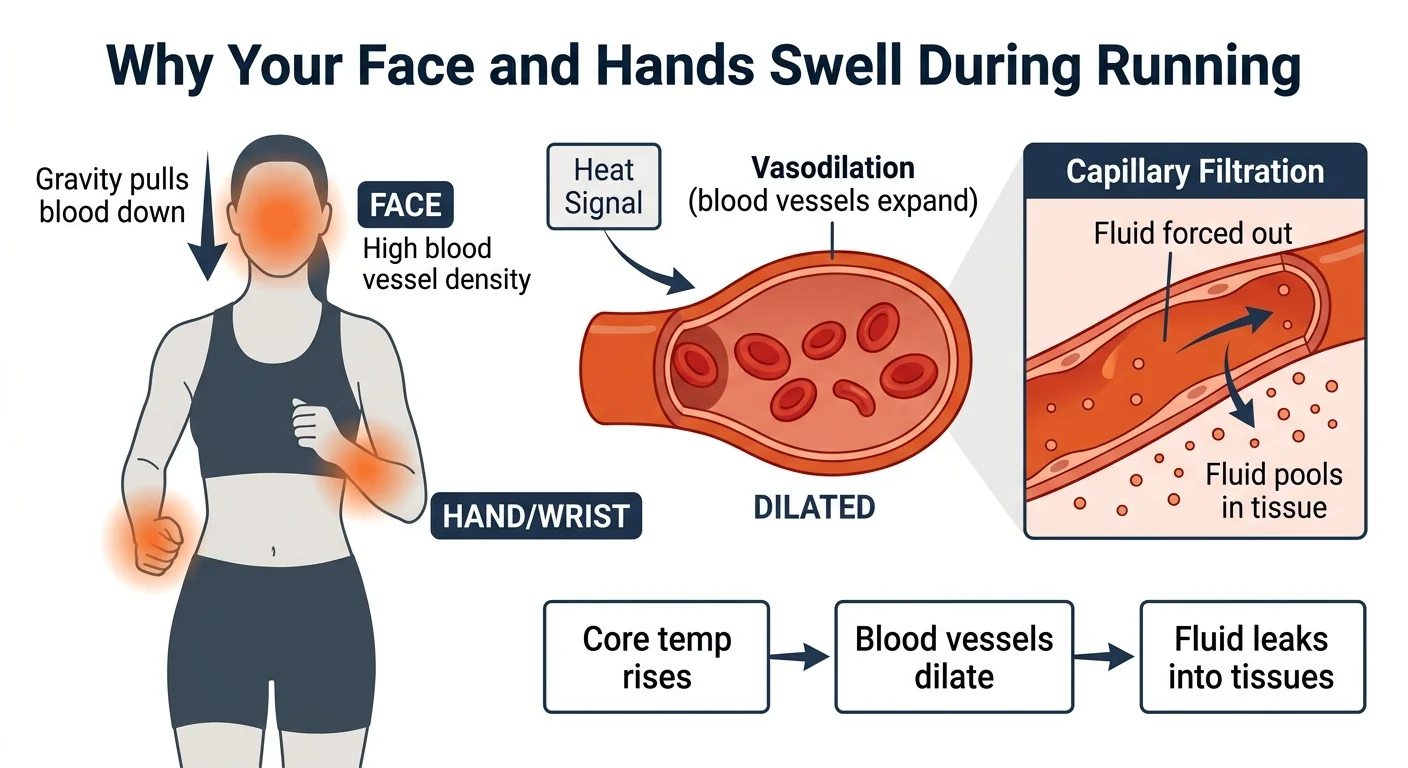
Your arms expertise the identical phenomenon.
Operating shoe consultants usually advocate sizing up half a dimension as a result of foot swelling throughout runs is so predictable that it’s grow to be a becoming commonplace.
The fluid pooling in these tissues has leaked out of your capillaries into the areas between your cells.
What Occurs to Your Fluids When You Run Lengthy Distances
Vasodilation explains the place the fluid comes from.
Your physique’s whole fluid steadiness throughout a marathon or future entails a extra advanced set of shifts.
Within the first couple of minutes of operating, there’s a speedy shift of vascular fluid into the tissue areas as fluid follows the strain gradient created by capillary hydrostatic strain.
Your plasma quantity quickly drops throughout this preliminary section.
Your physique has protecting mechanisms to forestall runaway plasma loss and cardiovascular collapse.
As you proceed operating, osmotically energetic compounds accumulate in your working muscle tissues: lactate, potassium ions, and phosphate.
These compounds draw water towards them, creating an osmotic gradient that opposes additional plasma loss.
Your plasma proteins, particularly albumin, are additionally being transported into the interstitial areas alongside the fluid shift.
Since proteins draw water towards them by osmotic strain, these proteins transferring into the areas round your cells proceed to tug fluid outward.
Your physique’s protecting mechanisms have interaction routinely to maintain plasma quantity steady regardless of the preliminary fluid leak, treating this fluid shift as a traditional a part of operating.
Your hydration state additionally issues.
In case you arrive on the run dehydrated, your physique conserves blood quantity by decreasing the quantity of plasma that shifts into tissue areas, which paradoxically means much less swelling throughout dehydration.
Can Overhydration Make Swelling Worse?
Many of the swelling you expertise throughout a run is regular, unavoidable, and innocent.
However there’s an edge case: excessive swelling that alerts harmful hyponatremia.
Train-associated hyponatremia (EAH) happens once you lose an excessive amount of sodium relative to the quantity of fluid you eat, dropping blood sodium under 135 millimoles per liter.
The prevalence in marathon runners ranges from lower than 1 to 22 %, relying on race period and situations.
EAH develops once you drink excessively above your thirst cue, triggering a hormonal response that intensifies fluid retention and dilutes sodium additional.
The swelling related to EAH is totally different from regular exercise-induced edema.
You’ll see extreme facial swelling, swollen arms and toes, weight achieve of two to three % or extra in the course of the run, and related signs like nausea, headache, and vomiting.
EAH is predominantly a danger for ultra-distance athletes and marathoners operating longer than 4 hours, not 5K or 10K runners.
In case you expertise extreme facial swelling mixed with speedy weight achieve of greater than 2 to three % throughout a race and signs like nausea or headache, search medical consideration.
For many runners, the repair comes down to 1 factor: drink to your thirst, to not a inflexible hydration schedule.
Your thirst mechanism is evolutionarily calibrated to maintain you in fluid steadiness, and overriding it in pursuit of most hydration creates the situations for hyponatremia with none profit.
If you’d like extra element on the overhydration drawback and keep away from it, the article on overhydration and sodium imbalance breaks down the mechanisms and sensible hydration technique.
RunnersConnect Bonus
Obtain your FREE Sweat Price Calculator now.
In case you are not sure about calculate how a lot water to eat, and electrolytes to use, this may offer you your actual wants.
Does Warmth Make Facial Swelling Worse When You Run?
In case you’ve seen your face puffing up extra throughout summer time runs, you’re observing an actual physiological amplification of the mechanisms already at work.
Warmth intensifies vasodilation, which implies extra capillary filtration strain and extra fluid leaking into facial tissues.
Throughout train in warmth, your sympathetic nervous system triggers vasodilation at a decrease core temperature than it might in cool situations, and the magnitude of that vasodilation is extra aggressive.
That is known as warmth acclimation: your nervous system learns to anticipate warmth stress and opens blood vessels proactively, redirecting much more blood to your pores and skin for cooling.
The mixed impact is direct: greater pores and skin blood circulation plus greater capillary hydrostatic strain means extra fluid leaking into facial tissues.
The impact is most pronounced within the first 10 to 14 days of warmth publicity, and it stabilizes after warmth acclimation because the response turns into extra environment friendly.
Virtually, this implies a summer time race will produce extra seen facial swelling than the identical tempo on a cool day.
To reduce swelling throughout sizzling runs, begin slower than your regular tempo.
Permit your cardiovascular system to stabilize earlier than pushing more durable, and step into shade throughout stroll breaks to let your core temperature drop.
Hydration throughout warmth nonetheless follows thirst-based steerage.
The amplified vasodilation creates swelling no matter how a lot you drink, and aggressive hydration solely provides the hyponatremia danger on high of regular heat-related swelling.
For a full breakdown of run safely in warmth, the article on heat exposure and thermoregulation covers pacing, acclimatization, and warmth stress risks.
When Swelling Is Regular vs. When to Fear
Understanding the physiology helps, however you additionally must know the place the road is between a traditional adaptation and a warning signal.
Regular exercise-induced facial and extremity swelling has predictable traits: gentle puffiness in your eyelids, cheeks, and lips that feels comfortable and painless.
The swelling is symmetric: each arms swell equally, each toes swell equally.
There’s no pitting indentation that persists once you press on the swollen tissue.
Regular swelling subsides inside 1 to 4 hours after you end operating, and also you’ll return to your pre-run weight or barely above it.
Weight achieve from a run mustn’t exceed 2 % of your physique weight.
In case you run for two hours and achieve greater than 2 % physique weight, fluid retention has shifted past regular adaptation.
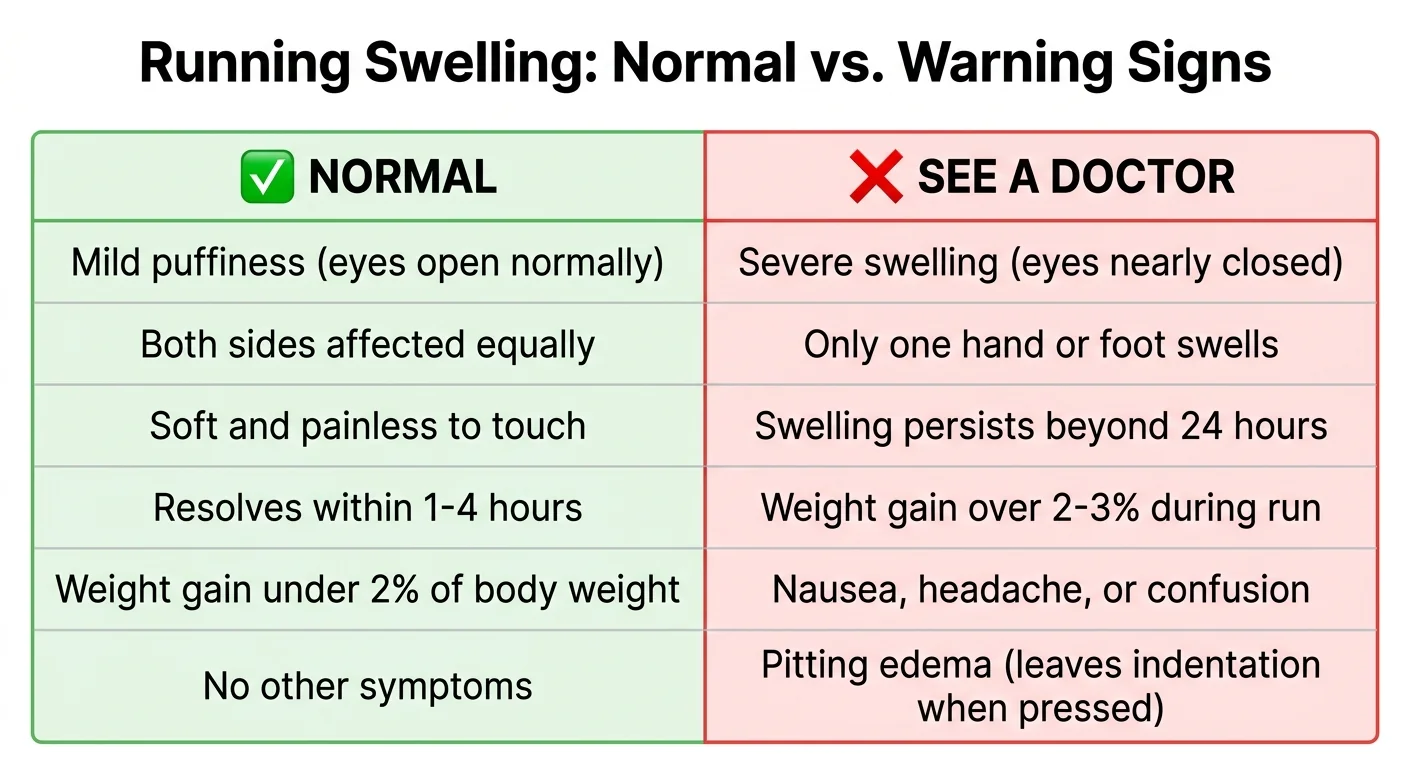
Warning indicators that swelling has grow to be regarding embrace:
- Extreme facial swelling the place your eyes are almost closed
- Uneven swelling (just one hand or foot is affected)
- Swelling that persists past 24 hours
- Swelling paired with numbness, tingling, nausea, headache, or confusion
Extreme swelling mixed with speedy weight achieve of greater than 2 to three % throughout or instantly after train and neurological signs warrants medical analysis.
Pitting edema that persists past a couple of hours additionally suggests one thing past regular adaptation.
This could immediate a name to your physician if it recurs throughout a number of runs.
RunnersConnect Bonus
Obtain your FREE Sweat Price Calculator now.
In case you are not sure about calculate how a lot water to eat, and electrolytes to use, this may offer you your actual wants.
Most runners experiencing regular exercise-induced swelling fear for nothing.
The variation resolves utterly in a single day, and the identical sample repeats on the subsequent future with no residual results.
In case your swelling is gentle, symmetric, painless, and resolves inside a couple of hours, you’re witnessing your cardiovascular system performing precisely because it ought to throughout endurance train.
