


You’ve been informed so as to add hill sprints to your coaching and to discover a “steep hill,” and also you’re now standing on the backside of the rise on the finish of your road questioning if it counts.
Hill gradient is the quantity that settles it, and as soon as you recognize what a 6% or a ten% grade seems like, you’ll be able to examine any hill along with your watch or a map.
Brief, all-out hill sprints are additionally a low-impact means for a distance runner to start out pace work, as a result of the slope lowers each your prime pace and the affect power when your foot lands.
On this article, you’ll be taught:
- What a hill’s gradient means and the way a % grade converts to levels
- How steep a 6%, 10%, 20% or 40% hill is in actual life
- Learn how to discover the gradient of any hill close to you
- What hill sprints do for a distance runner’s pace and operating economic system
- Why sprinting uphill is simpler in your hamstrings and joints than sprinting on the flat
- Which gradient to make use of, and a week-by-week plan in your first hill sprints
What Does a Hill’s Gradient Imply?
A hill’s gradient, additionally referred to as its grade, is how a lot peak you achieve for each unit of distance you journey ahead, written as a proportion.
On a ten% grade you climb 10 meters for each 100 meters of horizontal distance, which is identical as 10 toes for each 100 toes.
Grade and angle are two totally different scales, and mixing them up makes a hill sound steeper than it’s while you examine it.
A 100% grade means you climb so far as you journey ahead, and that slope is barely a 45-degree angle.
A ten% hill is a 5.7-degree slope, so a hill that appears light to the attention is usually steep sufficient for hill sprints.
The desk converts the grades you’ll see on GPS watches, treadmills and highway indicators into levels and actual climb.
| Grade | Angle | Climb per 100 m (or 100 ft) | What it means for a runner |
|---|---|---|---|
| 2% | 1.1° | 2 m (2 ft) | A slight rise you’d barely discover on a simple run |
| 6% | 3.4° | 6 m (6 ft) | The low finish for hill sprints and an excellent first hill |
| 10% | 5.7° | 10 m (10 ft) | A steep highway hill and the center of the hill dash vary |
| 15% | 8.5° | 15 m (15 ft) | A standard most treadmill incline |
| 25% | 14.0° | 25 m (25 ft) | The highest of the helpful hill dash vary |
| 35% | 19.3° | 35 m (35 ft) | The world’s steepest road |
| 100% | 45.0° | 100 m (100 ft) | A climb you’d scramble up along with your arms |
How Steep Is a 6%, 10%, 20% or 40% Hill?
A 6% to eight% hill is a gentle highway climb you can run up at straightforward tempo with out altering your stride a lot.
At 10% your stride shortens by itself throughout straightforward runs, and holding your regular straightforward tempo pushes your coronary heart price up.
A 20% grade is steep sufficient that strolling up it’s onerous work, and also you’ll principally discover it on quick residential streets, trails and ski slopes.
Something at 35% or above is a record-book slope.
Baldwin Street in Dunedin, New Zealand holds the title of the world’s steepest road with a gradient of 34.8%, so a “40% grade hill” is steeper than any public highway.
Gradient additionally modifications how a lot power every stride takes. A 2002 study of uphill and downhill running measured the power value of operating on slopes from flat to 45% in 10 runners.
Operating on a forty five% slope value 18.93 joules per kilogram per meter, greater than 5 occasions the three.40 joules per kilogram per meter the runners used on flat floor.
The equation from that examine places a ten% grade at about 65% extra power per meter than flat operating, and a 20% grade at about 2.5 occasions the flat value.
Every meter of a ten% hill prices about two-thirds extra power than a meter on the flat, so your legs have to supply extra power on each stride on the similar effort.
How Do You Discover the Gradient of a Hill?
The quickest strategy to discover a hill’s gradient is to run up it with a GPS watch. Strava additionally lists the typical grade of each section.
To work it out your self, divide the climb by the horizontal distance and multiply by 100.
- Discover the climb. Subtract the elevation on the backside of the hill from the elevation on the prime, utilizing a mapping app, your watch, or a biking route planner.
- Discover the gap. Measure the size of the hill on the identical map.
- Divide and multiply. A hill that climbs 8 meters over 100 meters has an 8% grade, and a hill that climbs 15 toes over 200 toes has a 7.5% grade.
Cellphone stage apps normally offer you an angle in levels, so convert it with the desk above. A 3-degree slope is a couple of 5% grade, and a 6-degree slope is a couple of 10.5% grade.
Common grade can disguise a steep part. For instance, a 300 m hill listed at 5% might have a 50 m stretch at 9%, and that steep 50 m is the half you need for 8-second sprints.
A treadmill exhibits its incline as a grade too, so you’ll be able to be taught what a 6% or 10% slope looks like earlier than you discover one exterior.
A 1996 treadmill study of 9 educated runners discovered {that a} 1% incline matched the power value of operating on a flat highway, as a result of a treadmill has no air resistance to push by way of.
Set the treadmill to a 1% incline to match operating on a flat highway, as a result of the belt removes the air resistance you’d face exterior.
RunnersConnect Bonus
Obtain your FREE Treadmill Information for Runners.
The information comprises 4 treadmill particular exercises assured to maintain you sane and match! You’ll be taught concerning the In-N-Out exercise, tips on how to “run like an Egyptian” and get my favourite “inexperienced eggs and ham” exercise.
What Do Hill Sprints Do for a Distance Runner?
Hill sprints make your leg muscular tissues produce extra power on each stride than flat operating on the similar effort, which is why runners use them as a running-specific type of energy coaching.
Operating uphill additionally recruits extra of your leg muscle. A study using MRI scans discovered girls operating onerous uphill used 73% of their leg muscle quantity, in contrast with 67% throughout the identical onerous effort on the flat.
The vastus muscular tissues on the entrance of the thigh have been 23% extra lively uphill, and the soleus within the calf was 14% extra lively.
That additional power carries over to your operating economic system, the quantity of oxygen you utilize to carry a given tempo.
Research has shown that 6 weeks of uphill interval coaching improved 5 km time trial efficiency by 2.0%, and the toughest uphill intervals improved operating economic system by 2.4%.

For a runner with a 25:00 5K, a 2.0% enchancment is about 30 seconds.
Steeper hills gave the largest positive aspects in a 2025 trial of 40 young middle-distance runners, which in contrast 8 weeks of uphill coaching on 2.5%, 5.1% and seven.6% gradients with a management group.
The 7.6% group improved its 30 m dash pace, 800 m time trial and energy endurance in contrast with the management group, and the 5.1% group improved solely its 800 m time.
These runners have been 16 to twenty years outdated, however the consequence matches the recommendation for adults too: a hill of about 7% to eight% trains your legs greater than a 2% or 3% rise on a standard highway route.
For extra on the pace and energy aspect of this exercise, see how explosive hill sprints build sprint speed when you’re previous the newbie stage.
Are Hill Sprints Safer Than Sprinting on Flat Floor?
Sprinting uphill lowers two of the hundreds that trigger essentially the most bother for distance runners who begin pace work, that are the affect of every touchdown and the way onerous your hamstrings work.
A study of uphill running discovered the affect power peak at touchdown disappeared at a 9-degree slope, whereas the push-off power rose 75%.
A 9-degree slope is a 15.8% grade, and the runners in that examine ran at 3 meters per second, which is 8:56/mi (5:33/km), so the drop in affect was measured at a simple operating tempo.
Your hamstrings additionally do much less work. A comparison of fast running on a 30% treadmill incline and on the flat discovered decrease hamstring exercise uphill, together with increased exercise within the calves, quadriceps and glutes.
A case study that recorded a hamstring strain as it happened positioned the damage within the late swing section.
That’s the second the hamstring is stretched because it slows the leg earlier than the foot lands.
That runner was on a 15% treadmill incline at 5.36 meters per second, about 5:00/mi (3:07/km), so a slope lowers the load in your hamstrings with out eradicating the danger of a pressure.
That’s why you heat up absolutely and dash at about 95% of your most effort as an alternative of an all-out 100%.
The trade-off is additional work in your calves and Achilles tendons, and that’s the explanation to start out with 1 or 2 sprints and add them slowly.
On the best way up, keep tall by way of your hips and pump your arms onerous whereas your stride shortens with the slope.
These are the identical cues that assist when running uphill on any run.
How Steep Ought to Your Hill Be for Hill Sprints?
A 6% to eight% grade is the best hill in your first hill sprints, and you may transfer to 10% after 2 to three months of standard periods.
Hill sprints for distance runners use gradients between about 6% and 25%, and the gradient you choose depends upon how lengthy you’ve been doing them.
- 6% to eight%: Steep sufficient to gradual your prime pace and cut back touchdown affect, and delicate sufficient that your stride nonetheless seems like operating. Begin right here.
- 10% to fifteen%: Extra power on each stride and extra work in your calves. Transfer right here after 2 to three months of periods on a 6% to eight% hill.
- Above 20%: Your stride turns into a brief, uneven climb, which builds energy however trains you much less for operating quick on the flat.
Choose a hill between 6% and eight% in your first hill sprints, with at the very least 50 m of regular slope and a easy floor.
Your hill additionally must be lengthy sufficient. At 5 to six meters per second, 4:28 to five:22/mi (2:47 to three:20/km), an 8-second dash covers 40 to 50 m, so that you want at the very least 50 m of regular slope with out a flat part or a pointy bend.
Select a easy paved highway, path or agency grass floor, as a result of free gravel and moist grass make you slip through the hardest a part of every push-off.
How Ought to a Newbie Begin Hill Sprints?
Begin with 2 sprints of 8 seconds on a 6% to eight% hill, twice per week, and add 1 or 2 sprints per week till you attain 10 per session.
Your first 2 sprints will really feel too straightforward.
For those who’ve by no means carried out maximal sprinting, your calves, Achilles tendons and hamstrings want just a few weeks to adapt to the power. Soreness from including too many sprints too quickly exhibits up 1 to 2 days later.
- Heat up first. Run 1 to 2 miles (1.6 to three.2 km) at straightforward tempo on flat floor, then do just a few dynamic drills corresponding to leg swings and strolling lunges.
- Dash for 8 seconds. Run up the hill at about 95% of your most effort, staying tall and driving your arms.
- Stroll again down. Recuperate absolutely between sprints, which takes 2 to three minutes, so each dash covers about the identical distance.
- Cease whereas the sprints are nonetheless quick. Finish the session when a dash covers much less floor than the primary one, even in the event you haven’t hit your deliberate quantity.
- Settle down. End with 10 to fifteen minutes of straightforward operating.
Add the hill sprints to the tip of a simple run, or do them as a brief session of their very own on a simple day.
Hold at the very least 1 straightforward day between hill sprints and your subsequent onerous exercise.
As soon as you are able to do 10 sprints of 8 seconds twice per week, stretch every dash to 10 seconds. A few month later, transfer to a ten% hill, and a month after that stretch every dash to 12 seconds.
Add just one or 2 sprints every week, and cease any session as quickly as your sprints decelerate.
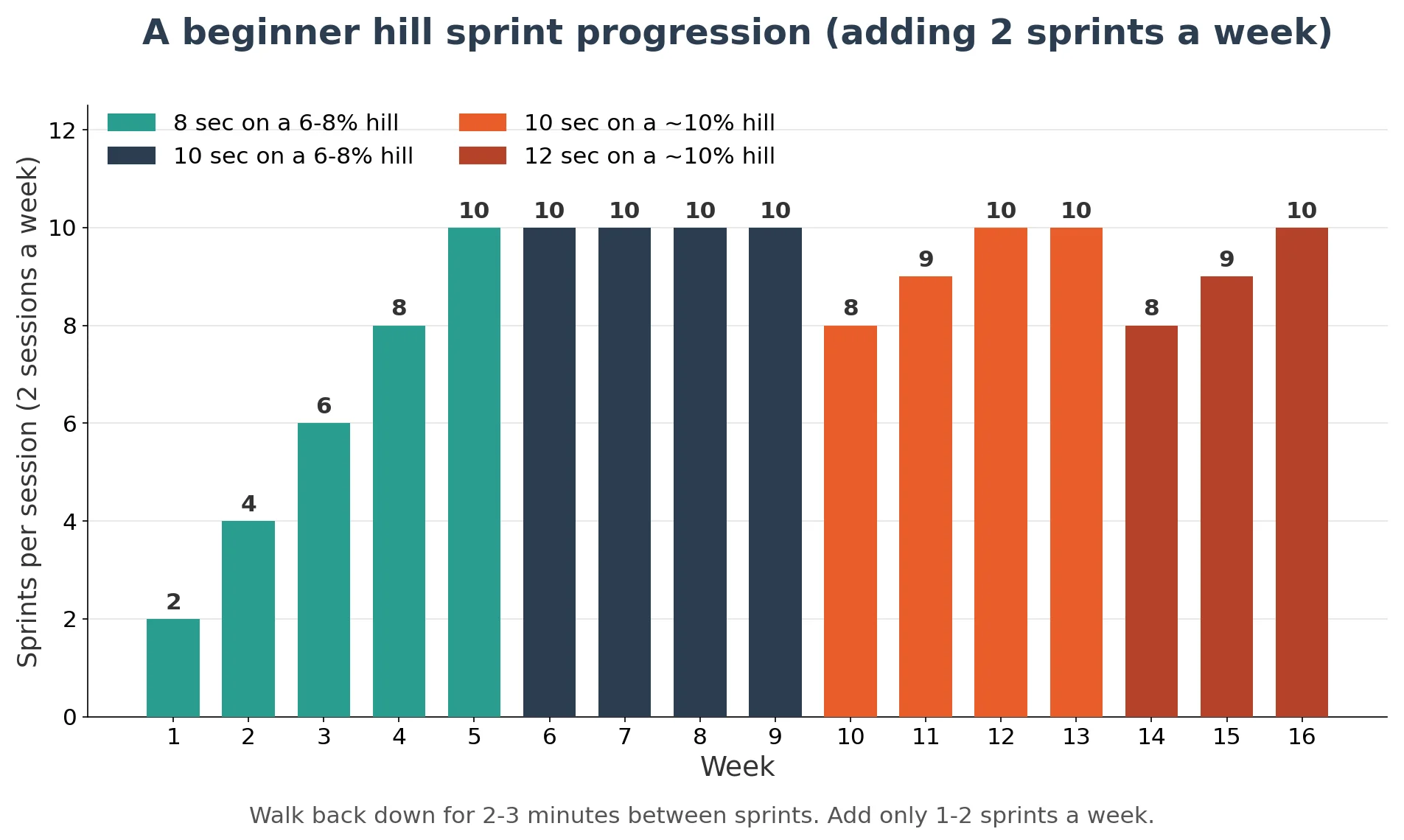
Right here is the total development in a single desk.
| Weeks | Sprints per session | Dash size | Hill gradient | Classes per week |
|---|---|---|---|---|
| 1 | 2 | 8 seconds | 6% to eight% | 2 |
| 2 to 9 | Add 1 to 2 per week, as much as 10 | 8 seconds | 6% to eight% | 2 |
| Subsequent 4 weeks | 10 | 10 seconds | 6% to eight% | 2 |
| Subsequent 4 weeks | 8 to 10 | 10 seconds | About 10% | 2 |
| After that | 8 to 10 | 12 seconds | About 10% | 2 |
