


You completed your final 20-miler two weeks in the past and ran the ultimate marathon-pace exercise Tuesday.
The calendar exhibits 21 days till the beginning line.
Now you get to chop your mileage in half, run lower than you’ve run in 4 months, and belief that the health you constructed remains to be there when the gun fires.
That is the marathon taper, and it’s the most misunderstood three weeks of the coaching cycle.
The bodily work is finished, and what occurs subsequent is a managed commerce between shedding gathered fatigue and defending the health you spent months constructing.
Taper too aggressively and also you lose the cardio sharpness that took you sixteen weeks to develop.
Taper too little and also you arrive on race morning with drained legs, depleted glycogen, and nothing left to spend.
This information walks by means of the analysis behind marathon tapering, the only rule that governs each determination throughout the three weeks, and a day-by-day protocol from three weeks out to race morning.
On this article, you’ll be taught:
- How lengthy a marathon taper ought to really final, based on the biggest meta-analysis ever run on the subject
- What occurs inside your physique through the taper and why three weeks is sufficient
- The quantity-versus-intensity rule that each research-backed taper follows
- Every week-by-week protocol for 3 weeks out, two weeks out, and race week
- The way to deal with taper nervousness, phantom pains, and the urge to squeeze in another onerous exercise
How lengthy ought to a marathon taper really final?
The analysis reply is sharper than most runners anticipate.
A meta-analysis of 27 tapering studies discovered that the only finest technique for peak race efficiency is a two-week taper the place coaching quantity drops by 41 to 60 p.c whereas coaching depth and frequency keep the identical.
These numbers come from Bosquet and colleagues on the College of Montreal, they usually stay the cleanest abstract of what the proof really helps.
The rationale marathoners sometimes stretch the taper to 3 weeks relatively than two is race distance.
Longer races produce extra gathered muscle harm and deeper glycogen debt than the 5K or 10K distances that made up a lot of the research in that meta-analysis.
Marathon coaching additionally tends to peak at increased whole volumes, which suggests the fatigue you’re making an attempt to shed is bigger in absolute phrases.
A separate review by Mujika and Padilla concluded that efficient tapers vary from 4 to greater than 28 days, with longer tapers higher suited to athletes carrying heavier coaching hundreds.
Three weeks is the window that offers a typical marathon runner sufficient time to get well from peak coaching with out dropping health.
Chopping that to 2 weeks is cheap for lower-mileage runners or athletes who reply rapidly to relaxation.
Stretching previous three weeks begins to compromise the cardio diversifications you spent months constructing.
The three weeks that observe break down into distinct jobs: the primary week shaves quantity whereas holding sharpness, the second begins the true minimize, and race week is pure preservation.
What really occurs in your physique throughout a marathon taper?
A well-executed taper is an energetic physiological course of, and calling it relaxation is the place most runners begin to lose the plot.
The adjustments are measurable and coordinated.
A comprehensive review of taper physiology documented coordinated enhancements throughout blood quantity, muscle glycogen, pink cell rely, muscle energy, testosterone-to-cortisol ratio, and temper, all taking place concurrently within the remaining two to 3 weeks earlier than competitors.

The muscular change that almost all straight impacts marathon efficiency is glycogen supercompensation.
Peak marathon coaching retains muscle glycogen partially depleted across the clock as a result of onerous periods empty the tank quicker than each day meals can refill it.
When quantity drops through the taper, recent carbohydrate begins touchdown in a muscle that has the urge for food however not has the expenditure, and saved glycogen rises well above pre-taper levels.
This is the reason a runner who ate the identical food regimen for sixteen weeks instantly feels heavier and stiffer throughout taper.
That feeling is a muscle loaded with gasoline, working precisely because it ought to.
Blood quantity and pink cell rely additionally climb, which improves oxygen supply at race depth.
Creatine kinase drops as muscle harm from peak coaching lastly clears, which is why the legs begin to really feel springy once more in week two.
Muscle energy output measured within the lab rises by 5 to 10 p.c throughout the taper in the identical research, and the energy beneficial properties are a part of why a well-rested marathoner feels fast on strides even after reducing weekly mileage by half.
Temper scores climb, perceived effort at submaximal paces drops, and sleep high quality sometimes improves.
These psychological adjustments matter as a result of the coaching you probably did for the earlier 4 months solely pays off when you present as much as the beginning line with the capability to entry it.
Must you cut back quantity or depth throughout a marathon taper?
Cut back quantity and hold depth.
That single rule governs each determination you make within the subsequent three weeks.
A study of competitive distance runners discovered {that a} seven-day taper with an 85 p.c discount in weekly quantity mixed with maintained interval depth dropped 5K time by three p.c and improved working economic system at 80 p.c of VO2max by six p.c.
The runners who minimize their mileage however did no depth work in any respect held their efficiency regular with out gaining.
The runners who minimize each noticed no profit.
Solely the group that minimize quantity whereas holding the onerous exercises onerous improved.
The identical sample confirmed up within the Bosquet meta-analysis, the place depth upkeep produced a optimistic efficiency impact whereas any discount in depth tended to erase the advantage of reducing quantity.
The sensible translation is that your exercises within the taper ought to really feel comparable in tempo to what you have been working in peak coaching, however they are going to be a lot shorter and spaced additional aside.
A ten mile tempo at marathon tempo in peak coaching turns into a 6 mile tempo at marathon tempo in week two.
A mile repeat session at threshold turns into fewer repeats on the similar tempo, not slower repeats over the identical distance.
The neuromuscular system wants the identical stimulus sign to maintain firing crisply, it simply wants much less of it.
Cardio sharpness is misplaced inside about 10 to 14 days of decreased depth, which is why backing off the onerous working too early is how runners find yourself working a slower race than they ran in coaching.
Chopping quantity with out reducing depth is the rule that separates a profitable marathon taper from a failed one, and the three weekly plans under are constructed round it.
Three weeks out: what does your first taper week seem like?
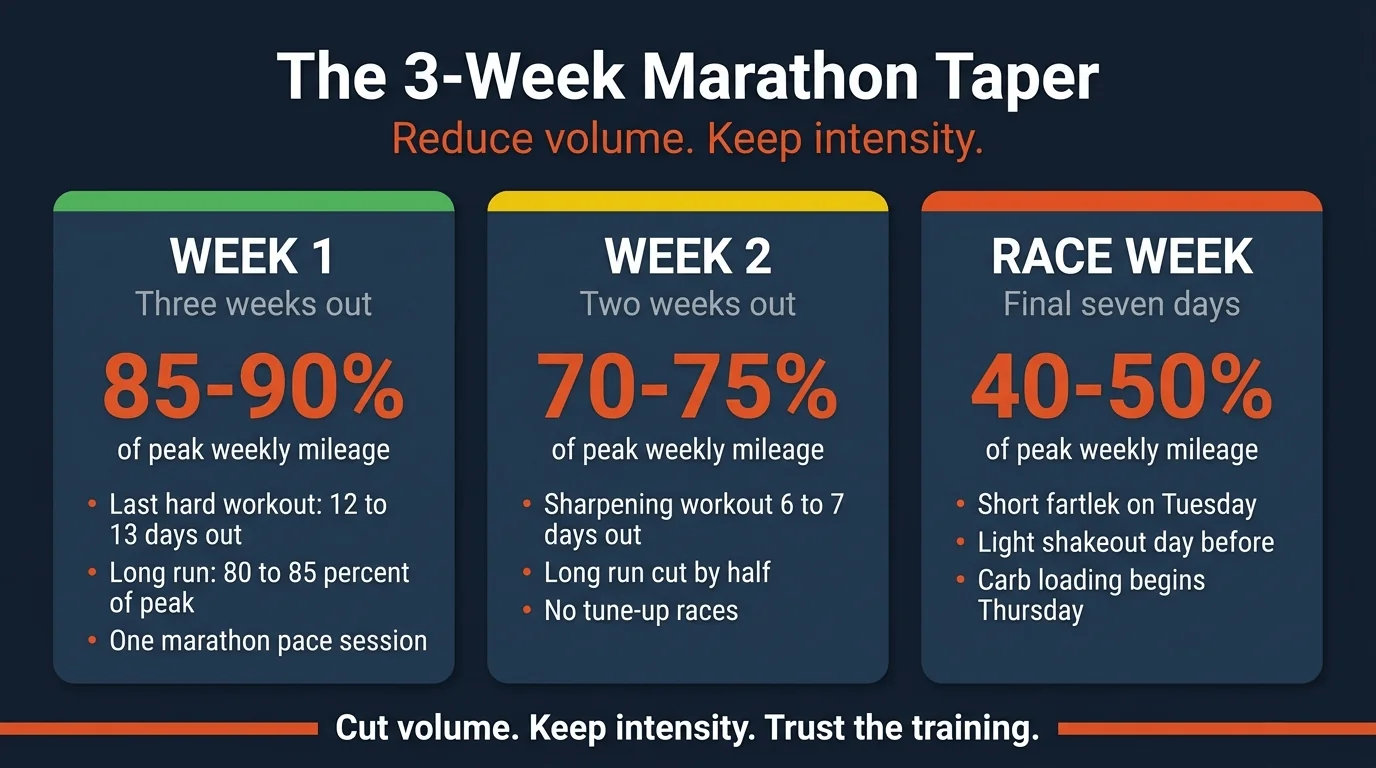
Week one is the transition week, and it ought to barely really feel like tapering.
Weekly mileage drops to about 85 to 90 p.c of peak.
In case your largest coaching week was 50 miles, the goal for week one is 43 to 45 miles.
That minimize is sufficiently small that it normally comes from trimming two or three miles from a restoration run and including a second relaxation day.
Your final actual exercise of the coaching cycle falls on Monday or Tuesday of this week, roughly 12 to 13 days earlier than the race.
The session must be marathon-specific relatively than a VO2max effort.
A typical instance is three to 4 miles at marathon tempo inside an extended run, or a 6 to eight mile development run ending at marathon tempo.
This isn’t the session to chase a brand new private finest on, and it’s not the session to skip since you are saving vitality.
The aim is to financial institution another high quality stimulus whereas there may be nonetheless sufficient time to get well earlier than race day.
Your future this week drops to 80 to 85 p.c of your peak future.
A 20-mile peak turns into a 16 to 17 miler.
Run it at a simple effort with the ultimate 3 to 4 miles picked as much as marathon tempo, which rehearses the final 6 kilometers of race-day pacing with out including additional fatigue.
The error to keep away from in week one is treating decreased mileage as permission to run all the pieces quicker.
Straightforward runs keep straightforward, future stays conversational, and the one onerous session is the one you deliberate.
Your remaining onerous exercise of the cycle ought to fall 12 to 13 days earlier than race day, not contained in the final two weeks.
Week one can be the fitting place to learn the common tapering mistakes that runners make within the remaining three weeks, as a result of the margin for error shrinks sharply as you progress into week two.
Two weeks out: how do you sharpen with out overreaching?
Week two is the place the true minimize begins.
Weekly mileage drops to 70 to 75 p.c of peak, which for a 50-mile runner lands round 35 to 38 miles.
The most important chunk of that discount comes out of the long term and the onerous exercise, not the straightforward restoration days.
Your sharpening exercise this week falls on Monday or Tuesday, roughly 6 to 7 days out from the race.
The whole quantity of this session drops by 60 to 70 p.c in contrast with a standard onerous day.
A traditional 9 mile tempo turns into a 3 to 4 mile tempo at marathon tempo.
Six by 1 mile at marathon tempo with a brief jog restoration is one other widespread construction, and it helps you to rehearse purpose tempo with out accumulating the sort of fatigue that wants 4 days to clear.
Hold the tempo trustworthy and minimize the quantity onerous.
That is the exercise the place most runners get into hassle by going quicker than marathon tempo as a result of their legs really feel recent from the decreased quantity.
Operating quicker right here teaches your physique the improper tempo and provides stress that you simply can’t get well from earlier than race day.
The long term this week drops to 50 to 60 p.c of your peak future.
A 20-mile peak turns into a ten to 12 mile run, saved at straightforward conversational effort the whole manner.
This run serves largely as a psychological rehearsal and a option to hold your weekly rhythm intact, since extra health beneficial properties are not out there within the remaining 14 days.
In case you really feel sluggish, minimize it to eight miles with out hesitation.
All the things else within the week stays at straightforward conversational tempo, with an additional relaxation day inserted if the climate will get sizzling or sleep has been poor.
Each onerous effort from this level ahead must be at marathon tempo or simpler, with no VO2max work, no threshold intervals, and no tune-up races.
Race week: what must you do every day earlier than the marathon?
Race week is the place self-discipline issues greater than health.
Weekly mileage drops to roughly 40 to 50 p.c of peak, with the discount unfold throughout each run on the schedule.
An 8-mile restoration run turns into a 4 to five mile shakeout, and any elective run will get minimize.
The each day template under works for a Sunday marathon and might be shifted sooner or later earlier for a Saturday race.
Monday: 3 to five miles straightforward, or a full relaxation day when you ran the Sunday future onerous.
Tuesday: the ultimate sharpening session, saved intentionally quick.
A typical race-week Tuesday exercise is a 15 to twenty minute straightforward warm-up, 6 to eight repetitions of two minutes at marathon tempo with 2 minutes straightforward working between, adopted by a ten to fifteen minute straightforward cool-down.
This session ought to go away you feeling sharp and barely energized, by no means fatigued.
Wednesday: relaxation day or half-hour of very straightforward working.
Thursday: 3 to 4 miles straightforward, largely to maintain the legs transferring.
Friday: 2 to three miles straightforward plus 4 to six strides of 20 to 30 seconds at marathon tempo or barely quicker, with full strolling restoration.
Saturday (day earlier than): 1 to three miles very straightforward, or a lightweight 10-minute jog, which primes the central nervous system and promotes blood stream with out including fatigue.
Sunday: race.
Carbohydrate loading sometimes begins Thursday or Friday and runs by means of Saturday, which aligns naturally with the mileage cuts already constructed into the schedule.
That is additionally the week to keep away from each unfamiliar variable.
New sneakers, new caffeine routines, new meals, new dietary supplements, and new stretching protocols all go on pause.
Race-week adjustments that felt intelligent on Tuesday are those that come again to hang-out you at mile 20.
Don’t introduce any meals, shoe, complement, caffeine protocol, or stretching routine throughout race week that you simply didn’t use throughout coaching.
RunnersConnect Bonus
Obtain your FREE Marathon Vitamin Throughout Your Taper Information.
The information incorporates a plan of precisely what you need to be consuming within the 5 days to three hours earlier than your race. We give particular meals suggestions to be sure to are prepared on race day.
How do you deal with taper nervousness and phantom pains?
Phantom accidents and race-week nervousness are a standard a part of the taper response for many marathoners.
The physiology assessment from Mujika and colleagues famous that temper enhancements, decrease perceived effort, and higher sleep present up alongside the muscular and metabolic adjustments.
That additional psychological vitality has to go someplace, and in most runners it redirects inward towards scanning the physique for indicators of damage.
A twinge within the knee that may have gone unnoticed in week 12 of coaching looks like a season-ender in week 19.
The sensible rule is straightforward.
If a ache exhibits up throughout taper that was by no means current throughout peak coaching, deal with it as noise for no less than 48 hours earlier than taking any motion.
Most phantom pains resolve on their very own as soon as the nervous system calibrates to the decreased coaching load.
If an actual ache does emerge, persevering with to run by means of it in race week does extra hurt than taking an additional day without work.
Anxiousness round tempo, climate, pacing technique, and fueling tends to peak within the remaining 72 hours.
The analysis treats taper nervousness as a sign that the nervous system has switched into pre-competition mode, and a lot of the psychological noise fades as soon as the gun goes off.
A deeper breakdown of why this occurs and how one can work by means of it lives within the Runners Join information to phantom pains and race-week anxiety, which covers the psychology in additional depth than this coaching information can.
If a brand new ache seems throughout taper that was not current throughout peak coaching, assume it’s noise till 48 hours of monitoring proves in any other case.
