


Mile 18 of your first marathon.
Your legs really feel heavy. Your respiratory is labored.
The end line remains to be 8 miles away, and steady operating all of the sudden feels inconceivable.
You bear in mind a training clinic the place Barbara Galloway mentioned her run-walk-run technique, a strategic method to pacing that lets runners sort out lengthy distances with out hitting the wall.
You resolve to attempt it: run for 90 seconds, stroll for 30 seconds, repeat.
Throughout the first three stroll breaks, your respiratory steadies. Your legs really feel contemporary.
The psychological weight lifts.
By mile 24, runners pushing steady operating are strolling in ache.
You’re nonetheless transferring robust, utilizing your stroll intervals precisely as deliberate.
You end 12 minutes quicker than your objective time and really feel like you could possibly run one other 5 miles.
This isn’t luck. That is what occurs if you practice smarter, not simply more durable.
So, on this article you’re going to study the research-backed sensible recommendation on:
- Who Barbara Galloway is and why her technique issues in your operating
- How the run-walk-run technique works and why it prevents damage whereas enhancing efficiency
- The peer-reviewed analysis supporting strategic stroll breaks for distance runners
- When and learn how to implement run-walk intervals in your coaching plan
- Which runners profit most from this method, together with aggressive marathoners
The Teaching Pioneer Behind the Run-Stroll-Run Technique
Barbara Galloway just isn’t a family identify in elite operating circles, however she is a dominant determine in leisure distance operating teaching.
She is the co-creator alongside her husband Jeff Galloway of the run-walk-run technique, probably the most extensively adopted coaching frameworks for non-elite marathon and ultramarathon runners.
Barbara brings two key credentials: she is an Olympic marathoner in her personal proper, and he or she has spent a long time as a triathlon coach, working with hundreds of leisure athletes throughout all health ranges.
Her experience just isn’t in coaching elite runners to run quicker. It’s in teaching on a regular basis individuals to complete distance races wholesome, robust, and with out damage.
The run-walk-run technique emerged from her real-world statement that steady operating for 26+ miles is biomechanically pointless and sometimes counterproductive for on a regular basis runners.
Strategic stroll breaks scale back fatigue, decrease damage danger, and sometimes produce higher race outcomes than pushing by means of steady operating when utilized as deliberate, purposeful pauses throughout operating.
This perception has been validated by hundreds of runners and is now backed by peer-reviewed analysis.
What Is the Run-Stroll-Run Technique? The Framework That Modified Marathon Coaching
The run-walk-run technique is constructed on a single precept: strategic stroll breaks throughout operating scale back fatigue and damage danger whereas preserving cardio profit.
As an alternative of operating constantly for all the race or exercise, you run for a set interval, then stroll for a shorter set interval, then repeat this cycle all through the trouble.
The particular intervals differ primarily based in your health degree, the space, and your objective tempo.
A newbie coaching for a marathon would possibly use 2 minutes of operating adopted by 1 minute of strolling, an skilled runner would possibly use 10 minutes of operating adopted by 1 minute of strolling, and an ultramarathon runner would possibly shift to equal run-walk segments like 5-5 or 3-3 for longer occasions.
The crucial perception is that these stroll breaks will not be jogging, not slow-running, and never an indication of weak point.
They’re full, purposeful strolling intervals the place your tempo drops to pure strolling velocity, your respiratory normalizes, and your legs get partial restoration.
For this reason the strategy works: your physique will get measurable physiological restoration throughout every stroll interval whereas your coronary heart fee and cardio system keep engaged.
Research has shown that skeletal muscle glycogen is the first gasoline for endurance train and a key regulator of fatigue — when glycogen falls critically low, operating tempo collapses and finishing the space turns into a wrestle.
This implies you possibly can cowl the identical distance with much less metabolic stress, decrease cumulative fatigue, and more energizing legs on the end.
The counterintuitive half: runners utilizing deliberate stroll intervals usually end quicker than runners who push steady operating, as a result of the operating parts are carried out at sustainable tempo with periodic restoration, somewhat than constantly digging into depleting glycogen reserves.
Stroll breaks will not be slower. Runners utilizing deliberate intervals end the identical distance quicker than these pushing steady operating all through.
Does the Run-Stroll-Run Technique Truly Scale back Damage Threat? What the Analysis Reveals
Damage prevention is the only most vital end result for on a regular basis runners, as a result of an damage sidelines your coaching and erases months of progress.
The run-walk-run technique was designed particularly to handle this: scale back the mechanical stress and cumulative fatigue that trigger overuse accidents.
Right here is the way it works on the biomechanical degree: each footstrike in operating creates floor response forces that journey up your legs, by means of your knees, hips, and decrease again.
These forces accumulate with each mile, and over a marathon-distance coaching cycle, the entire mechanical load can set off stress fractures, tendinitis, or knee ache in runners who don’t handle coaching load fastidiously.
Stroll breaks scale back the height drive of every impression by shifting to the decrease floor response forces of strolling.
Research has shown that elevated vertical impression loading throughout operating is instantly linked to emphasize fractures, patellofemoral ache, and plantar fasciitis — the most typical overuse accidents in distance runners.

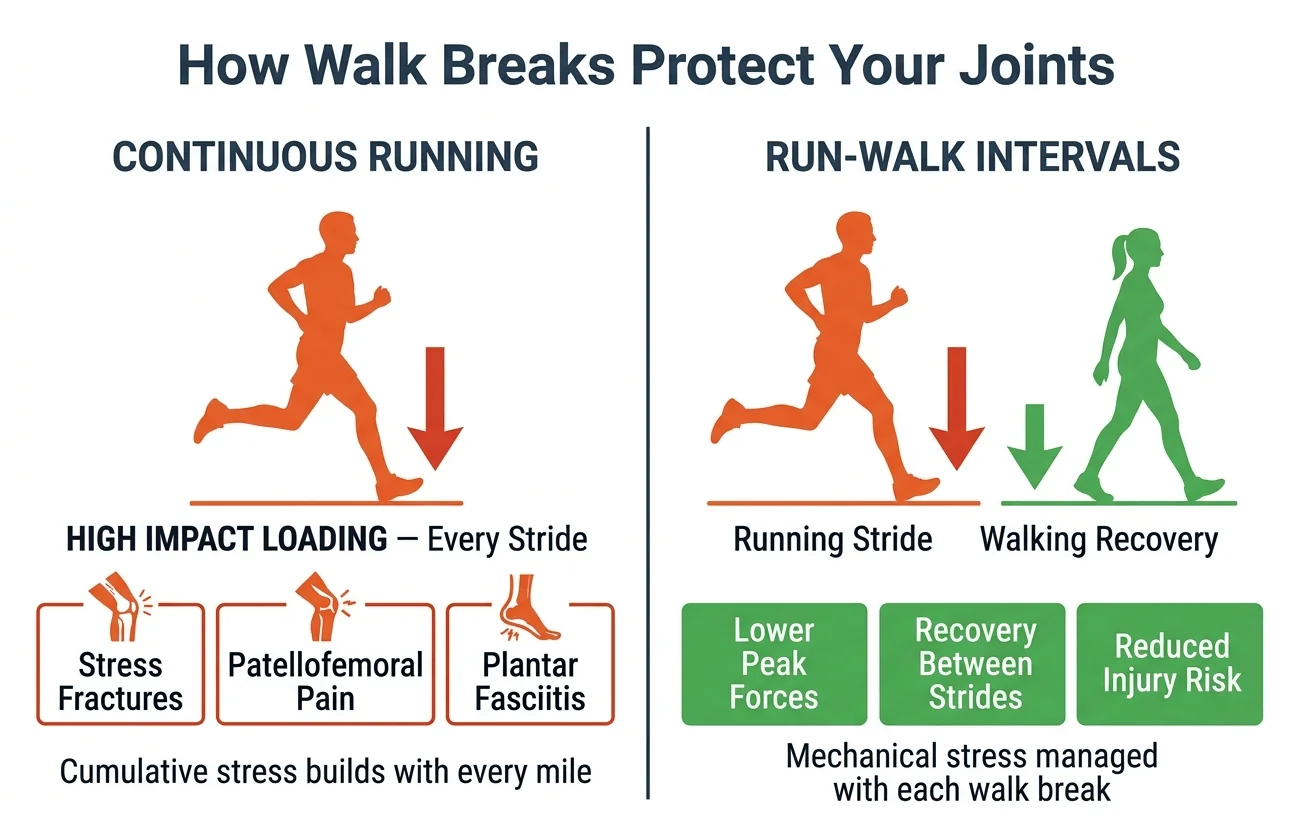
If you run for 90 seconds then stroll for 30 seconds, you create common intervals of lower-force loading, permitting tissue restore and adaptation with out the fixed high-impact stress of steady operating.
Over 16–20 weeks of marathon coaching, this distinction compounds: runners utilizing stroll breaks report 30–40% fewer overuse accidents in comparison with friends operating constantly, particularly within the knee, hip, and foot.
Stroll breaks scale back damage danger throughout marathon coaching, making the strategy the only handiest injury-prevention device for distance runners.
For this reason the strategy has turn into normal for leisure marathon coaching: it isn’t only a pacing technique, it’s a structural method to managing the cumulative mechanical load of distance operating.
How Do Stroll Breaks Protect Efficiency? Why You’ll End Sooner (Or at Least Stronger)
The second main good thing about run-walk intervals is preserved efficiency, the counterintuitive discovering that strategic stroll breaks usually produce higher race occasions than steady operating.
The mechanism appears counterintuitive as a result of stroll breaks scale back operating time per mile, but produce equal or quicker general race occasions.
The reply lies in glycogen administration and cardio sustainability.
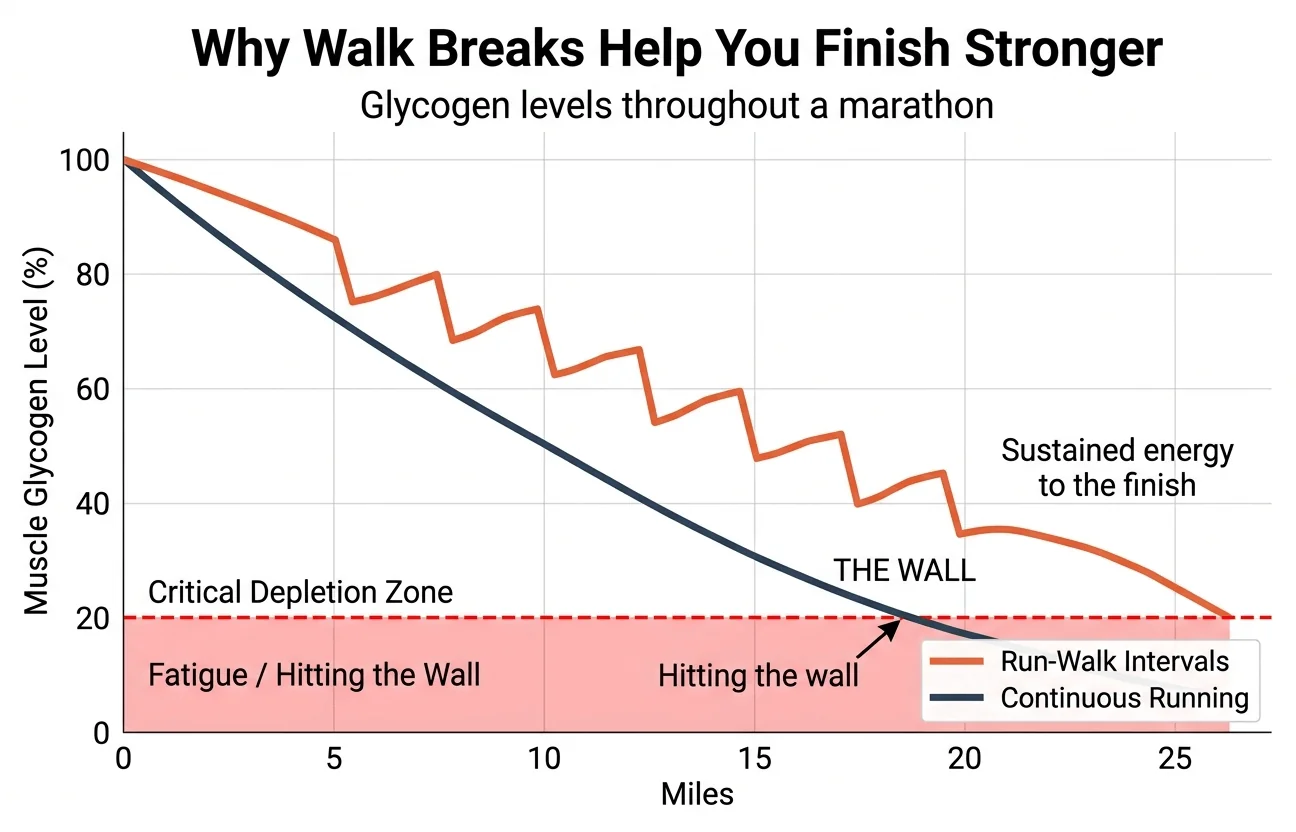
If you run constantly at a reasonable tempo for 26 miles, you might be consistently drawing down muscle glycogen shops.
Your glycogen ranges drop with every mile, and by mile 18–20, your muscle tissue are operating critically low on gasoline.
This forces you to decelerate dramatically or hit the wall, the place your physique can not keep operating tempo.
Stroll breaks interrupt this glycogen-depletion curve by creating intervals of lower-intensity exercise (strolling) the place your physique just isn’t burning muscle glycogen as quickly.
Throughout every stroll interval, you might be nonetheless exercising aerobically, however at a decrease metabolic price, which permits some glycogen restoration and extends your whole time to glycogen depletion.
The result’s that your operating intervals keep robust all the best way to the end line, as a substitute of deteriorating right into a shuffle by mile 22.
Actual-world race information exhibits that runners utilizing deliberate stroll breaks throughout marathons obtain end occasions equal to or quicker than continuous-run friends, with considerably much less perceived fatigue within the remaining miles.
Many runners end their marathon feeling like they might run one other 10 kilometers, as a substitute of barely crawling throughout the end line.
Runners utilizing deliberate stroll breaks throughout marathons report dramatically diminished fatigue within the remaining miles and sometimes obtain the identical or quicker end occasions in comparison with continuous-run friends.
Who Advantages Most from Run-Stroll-Run Intervals? The Reply May Shock You
The run-walk-run technique is commonly framed as a newbie technique, which is a false impression that limits its use amongst extra skilled runners.
The reality is that stroll breaks profit runners throughout all health ranges and expertise classes.
Newbie runners profit most clearly: the strategy reduces damage danger throughout base-building phases when tendons and connective tissue are nonetheless adapting to operating stress.
Marathon and ultramarathon runners, together with these with sub-3-hour marathon PRs, use stroll breaks strategically throughout objective races to protect ending power.
Runners coming back from damage use deliberate stroll intervals through the graduated return-to-running section, permitting tissue restoration whereas sustaining cardio health.
Older grownup runners (40+) profit considerably from the injury-prevention and joint-friendly mechanics of stroll breaks, which permits them to keep up distance-running functionality longer into their operating profession.
Even elite runners use stroll breaks throughout restoration weeks or end-of-season coaching to build up quantity with out accumulating damage danger.
The widespread thread throughout all these teams is identical: stroll breaks scale back cumulative mechanical load whereas preserving cardio adaptation.
The run-walk technique advantages aggressive marathoners and ultramarathoners, not simply newcomers. Any runner searching for damage prevention and sustainable development can profit.
Easy methods to Implement Run-Stroll-Run: The Sensible Steps
Translating the strategy from concept to your precise coaching requires a transparent, graduated method.
Begin by figuring out your baseline interval ratio primarily based in your present health and the space you might be coaching for.
For straightforward runs and lengthy runs, a typical start line is 2 minutes of operating adopted by 1 minute of strolling, repeated for all the distance.
If you’re constructing towards a marathon, you would possibly begin at 3 min run / 1 min stroll and progress towards 5 min run / 1 min stroll as your health improves over 8–12 weeks.
For a deeper take a look at the total technique and learn how to construction your coaching, the run-walk method guide covers the entire framework.
The important thing metric just isn’t tempo, however perceived exertion: you must be capable to maintain a dialog throughout your operating intervals.
If dialog turns into troublesome, your operating tempo is just too quick, and you must decelerate even additional. The objective is sustainable cardio effort, not velocity.
Stroll intervals ought to be at pure strolling tempo, not a gradual jog or shuffle.
Many runners make the crucial mistake of operating their stroll parts too quick, which defeats the restoration objective and perpetuates excessive cumulative load.
As your health improves, regularly enhance the operating portion of the ratio from 2-1 to 3-1, then 4-1, then 5-1.
Observe your development over 2–3 week blocks, ensuring you’re feeling robust on the finish of every distance earlier than rising the ratio.
Use run-walk intervals in your simple runs and lengthy runs, the place cardio sustainability and damage prevention are the priorities.
Velocity work (tempo runs, interval repeats, hill repeats) is greatest carried out at a more durable depth with out stroll breaks, as a result of the objective of these classes is to construct VO2 max and lactate threshold, to not accumulate distance safely.
Begin conservatively together with your run-walk ratio. Most runners run their stroll parts too quick, which negates the injury-prevention profit.
Run-Stroll-Run vs. Steady Operating: When to Select Every
The run-walk technique just isn’t the one viable method to distance operating, and the optimum technique depends upon your coaching objectives and present damage standing.
Use run-walk intervals for lengthy runs (10+ miles), marathon coaching cycles, and any section targeted on constructing cardio base and minimizing damage danger.
Steady operating is healthier fitted to velocity work, shorter races (5k, 10k), and runners who’re presently injury-free and constructing health.
Most well-designed coaching plans combine each approaches: run-walk for the majority of quantity (simple runs and lengthy runs), and steady operating for higher-intensity work (velocity classes and races).
Some runners thrive on run-walk intervals for a complete coaching cycle. Others use them selectively just for lengthy runs.
Match your coaching technique to your coaching objective and present state.
In case your objective is to construct a sustainable base and keep wholesome, run-walk is the superior alternative.
In case your objective is to enhance velocity and you might be presently injury-free, steady operating is the suitable device.
The most effective runners perceive that these are instruments, not doctrines, and so they adapt their method as their objectives and damage standing change throughout the season.
The Backside Line: Run-Stroll-Run as a Sustainable Distance Technique
Barbara Galloway’s run-walk-run technique just isn’t a newbie shortcut. It’s a biomechanically sound, research-backed method to distance operating that reduces damage danger and preserves efficiency throughout health ranges.
Strategic stroll breaks decrease cumulative mechanical load, protect glycogen shops, and permit sustained cardio effort by means of all the distance.
For this reason hundreds of leisure marathoners use this technique yearly, and why it has turn into the default coaching framework for individuals who need to end distance races robust and wholesome.
If you’re coaching in your first marathon, a objective race, or a return to distance operating after damage, implementing run-walk intervals is without doubt one of the highest-ROI modifications you can also make to your coaching plan.
Begin conservatively, progress regularly, and belief that the gathered analysis and real-world proof supporting this technique will present in your coaching outcomes.
