


Coaches have yelled “fast toes” at drained runners for many years, normally on the final lap, when your stride begins to stretch out into an extended, loping gait.
Your working velocity comes from 2 numbers multiplied collectively: how lengthy every step is and what number of steps you are taking per minute.
Researchers have now run dozens of research on the second quantity, as a result of altering it additionally modifications how a lot load your hips and knees take in on each step.
On this article, you’ll study:
- The distinction between stride frequency, step price, and cadence
- How stride size and stride frequency mix to set your tempo
- What a 5% or 10% quicker step price does to the load in your knees and hips
- Whether or not faster steps decrease your damage danger
- Why newcomers usually decide a stride frequency beneath their most effective one
- Easy methods to measure your stride frequency and lift it with out wrecking your kind
What Is Stride Frequency in Working?
Stride frequency is what number of strides you are taking per minute of working, and runners and watches use it interchangeably with step price and cadence.
The phrases journey folks up as a result of a stride and a step are technically completely different. A step runs from one foot touchdown to the opposite foot touchdown, and a stride is 2 steps, from one foot touchdown to that very same foot touchdown once more.
Which means 85 strides per minute and 170 steps per minute describe the identical runner.
This text makes use of steps per minute, the unit most working watches present, and converts any research that reported strides.
In one of many research beneath, new runners selected about 156 steps per minute and skilled runners about 169, and your personal quantity rises as you velocity up. If you wish to see the place your peak places you in that vary, our information to running cadence by height breaks it down.
How Do Stride Size and Stride Frequency Make You Quicker?
Your tempo is your step size multiplied by your step price, so you possibly can solely velocity up by protecting extra floor per step, taking extra steps per minute, or each.
For instance, 8:00/mi (4:58/km) tempo is 3.35 meters per second.
At 160 steps per minute, every step has to cowl about 1.26 meters to carry that tempo. Bump your price to 180 steps per minute and every step solely must cowl about 1.12 meters.
At distance-running speeds, you get most of your further velocity from protecting extra floor with every step. A 2012 study modeled the leg muscle mass of runners from a sluggish jog to an all-out dash.
As much as 7 meters per second, about 3:50/mi (2:23/km), these runners sped up primarily by lengthening their stride.
Your calf muscle mass produce most of that further step size. The extra power they push into the bottom, the extra time you spend within the air and the extra floor every step covers.
Solely above 7 meters per second, nicely into sprinting, did the runners shift to swinging their legs by means of quicker.
As much as about 3:50/mi (2:23/km), runners velocity up primarily by pushing more durable into the bottom to elongate every stride.
At a straightforward tempo, the case for altering your stride frequency rests on the way it masses your knees and hips.
RunnersConnect Bonus
Obtain your FREE Information to Minimalist Working.
Supplying you with a straightforward to comply with, printable pointers for how you can alter your coaching, slowly add-in barefoot working, and the precise power routine you could get your toes wholesome and robust!
What Occurs to Your Knees and Hips When You Take Faster Steps?
Taking faster steps on the identical tempo shortens every step, which lowers the load your knees and hips have to soak up each time your foot lands.
Research has shown {that a} 5% quicker step price cuts the power your knee absorbs on touchdown, and a ten% quicker price cuts hip loading too.

The 45 runners in that research additionally rose and fell much less with every step, and their knee bent much less on touchdown. Dropping step price 10% beneath their pure rhythm raised the load on the hip, knee, and ankle.
The identical analysis group went on to estimate the power on the kneecap. In 30 healthy runners, a ten% quicker step price lower peak power between the kneecap and thigh bone by 14%.
That issues in case you’ve had runner’s knee, as a result of that joint is the place the ache comes from.
A bigger evaluation backs up the path of those modifications. A 2022 review of 37 studies concluded that elevating step price lowered or didn’t change the forces measured on the ankle, knee, and hip.
Reducing step price did the reverse, elevating these forces or leaving them unchanged.
Does a Increased Stride Frequency Forestall Working Accidents?
Elevating your stride frequency lowers the influence measures linked to damage, however no giant trial has but proven that elevating it prevents accidents.
The hyperlink between influence and damage has firmed up for the reason that early research, which solely seemed again at runners who had already been damage. A 2016 study followed 249 female runners forward in time after measuring how briskly power constructed up when every foot landed.
The ladies who went on to get a medically recognized damage had greater loading charges than the ladies who by no means bought damage. Runners above the research’s cutoff for loading price had 2.72 occasions the percentages of a recognized damage.
Elevating your step price lowers that loading price, and the change sticks. A randomized trial of 30 runners with high impact forces cued them to lift their step price by 7.5% throughout 8 out of doors runs with a wi-fi sensor.
The runners raised their step price by 8.6%, and their peak loading price dropped by 17.9%.
The work their knee muscle mass did to soak up every touchdown dropped by 21.1% per kilometer, and each modifications have been nonetheless in place a month later.
A 5% to 10% enhance in step price is sufficient to decrease knee loading, and the runners in that trial nonetheless held it a month after 8 periods.
The damage proof itself is skinny. The 2022 overview discovered solely 2 research that measured damage outcomes, and each have been in runners with kneecap ache.
These runners reported much less ache and scored greater on questionnaires about every day knee use at 4 and 12 weeks after elevating their step price.
Which means a faster cadence is price making an attempt in case you’ve had kneecap ache, and it lowers the loading price tied to damage within the 249-runner research.
Is Your Pure Stride Frequency Already the Most Environment friendly?
Skilled runners are inclined to settle near their most effective stride frequency on their very own, whereas newer runners have a tendency to choose one which’s decrease than their optimum.
Stride size follows the identical rule. A 1982 study of 10 runners assorted their stride size as much as 20% of leg size above and beneath their pure stride and measured their oxygen use every time.
The runners’ personal stride used nearly precisely the least oxygen, solely 0.2 milliliters per kilogram per minute greater than their true optimum.
New runners don’t get as shut.
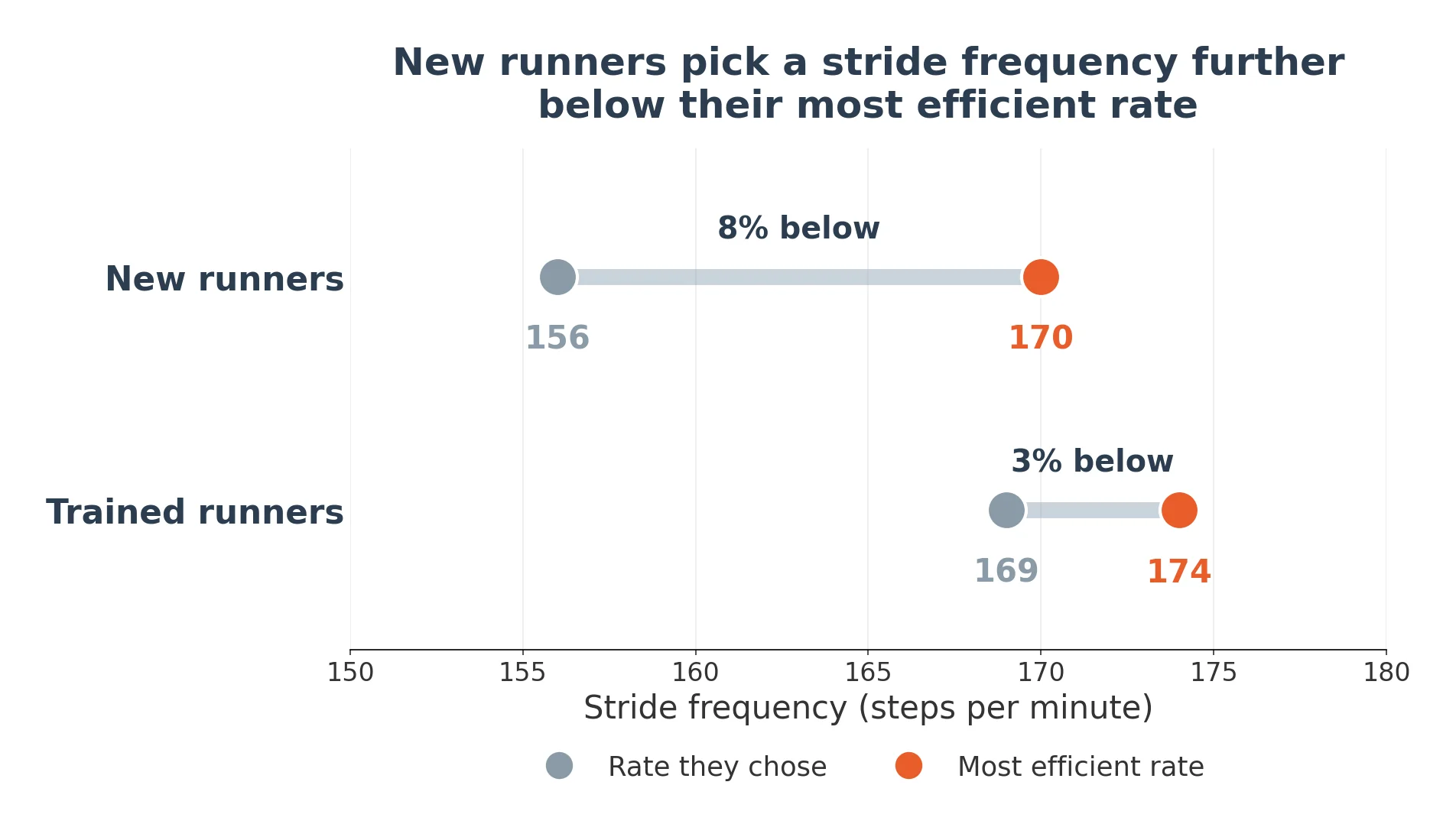
A 2014 study found that new runners selected a stride frequency about 8% beneath their most effective price, whereas skilled runners selected one about 3% beneath theirs.
The researchers ran 10 novices and 10 skilled runners at 7 completely different stride frequencies set by a metronome and located the speed the place every runner used the least oxygen.
The skilled runners selected about 169 steps per minute, in opposition to a most effective price of about 174 steps per minute. The novices selected about 156 steps per minute, in opposition to a most effective price of about 170 steps per minute.
Which means a more moderen runner has extra room to achieve from a small cadence enhance, whereas an skilled runner is already near the very best price for his or her physique.
Elevating your cadence can even really feel awkward within the brief time period. The 2022 overview discovered very restricted proof that runners rated their effort greater proper after they elevated their step price.
How Do You Measure and Enhance Your Stride Frequency?
Examine your present step price on a straightforward run first, then elevate it by 5% to 10% utilizing a metronome or music because the cue.
In case your watch doesn’t present cadence, depend each time your proper foot lands for 30 seconds at your regular straightforward tempo. Multiply that depend by 4 to get steps per minute.
Use these steps to alter it:
- Set a goal 5% to 10% above your present price. When you run 160 steps per minute, intention for 168 to 176. Going from 168 to 180 steps per minute is a 7% change, contained in the vary the research examined.
- Use a beat to cue it. Set a metronome app, or a playlist with an identical beat, to your goal price and match your footfalls to it.
- Begin with brief blocks. Maintain the brand new rhythm for 3 to five minutes inside a straightforward run, then return to your regular price and repeat.
- Hold your tempo the identical. Let every step cowl much less floor so your velocity stays the identical.
- Cease when it feels computerized. When you maintain the brand new price with out the beat, drop the cue and examine your watch from time to time.
A 2026 review of 20 studies and 483 runners discovered that step price coaching over a number of periods raised step price by about 12 steps per minute, whichever kind of cue the runners used.
Purpose for a 5% to 10% enhance in stride frequency, even when that leaves you wanting the favored 180 steps per minute goal.
For drills and kind cues that assist the brand new rhythm stick, see our information on how you can increase your running turnover.
Right here’s a abstract of what the analysis reveals about stride frequency:
| Query | What the analysis reveals | What to do |
|---|---|---|
| How do distance runners velocity up? | Principally by lengthening their stride, as much as about 3:50/mi (2:23/km) | Construct leg power to push more durable into the bottom |
| What does a faster step price do to your joints? | +10% lower peak kneecap power by 14% and diminished hip and knee loading | Attempt +5% to +10% in case you’ve had knee ache |
| Does influence matter for damage? | Runners above the loading-rate cutoff had 2.72 occasions the percentages of a recognized damage | Decrease your loading price with faster, shorter steps |
| Can you retain a brand new step price? | +8.6% held a month after 8 periods | Follow with a beat, then drop the cue |
| Is your pure price environment friendly? | Novices ran 8% beneath their optimum, skilled runners 3% | Newer runners have essentially the most to achieve |
