


Coaching for a marathon burns 1000’s of energy per week. It solely is smart that every one that work would lead to weight reduction.
So why do some runners truly acquire weight throughout marathon coaching?
In case you’ve observed the dimensions creeping up regardless of logging extra miles than ever, you’re not alone. And generally, the load acquire is both a traditional coaching adaptation or a fixable vitamin mistake.
So, on this article you’re going to be taught the research-backed sensible recommendation on…
- The three physiological causes marathon coaching may cause weight acquire (and why 2 of them are literally good indicators)
- Why consuming extra throughout arduous coaching blocks received’t make you acquire fats
- The widespread post-run vitamin errors that undo your calorie deficit
- Tips on how to inform in case your weight acquire is muscle and glycogen or precise fats
Why Does Marathon Coaching Trigger Weight Acquire?
Three issues occur in your physique throughout marathon coaching that may push the quantity on the dimensions up.
Two of them imply your coaching is working.
How Does Muscle Mass Have an effect on the Scale Throughout Marathon Coaching?
Distance working promotes muscle development, particularly within the legs.
Add any power coaching or hill work and the impact is amplified.
Muscle tissue is denser than fats tissue, roughly 20% heavier by quantity.
In case your physique seems to be the identical or trimmer however the scale reads increased, you’re probably buying and selling fats for muscle.
That’s a efficiency acquire, not an issue.
Why Does Glycogen Storage Add Weight?
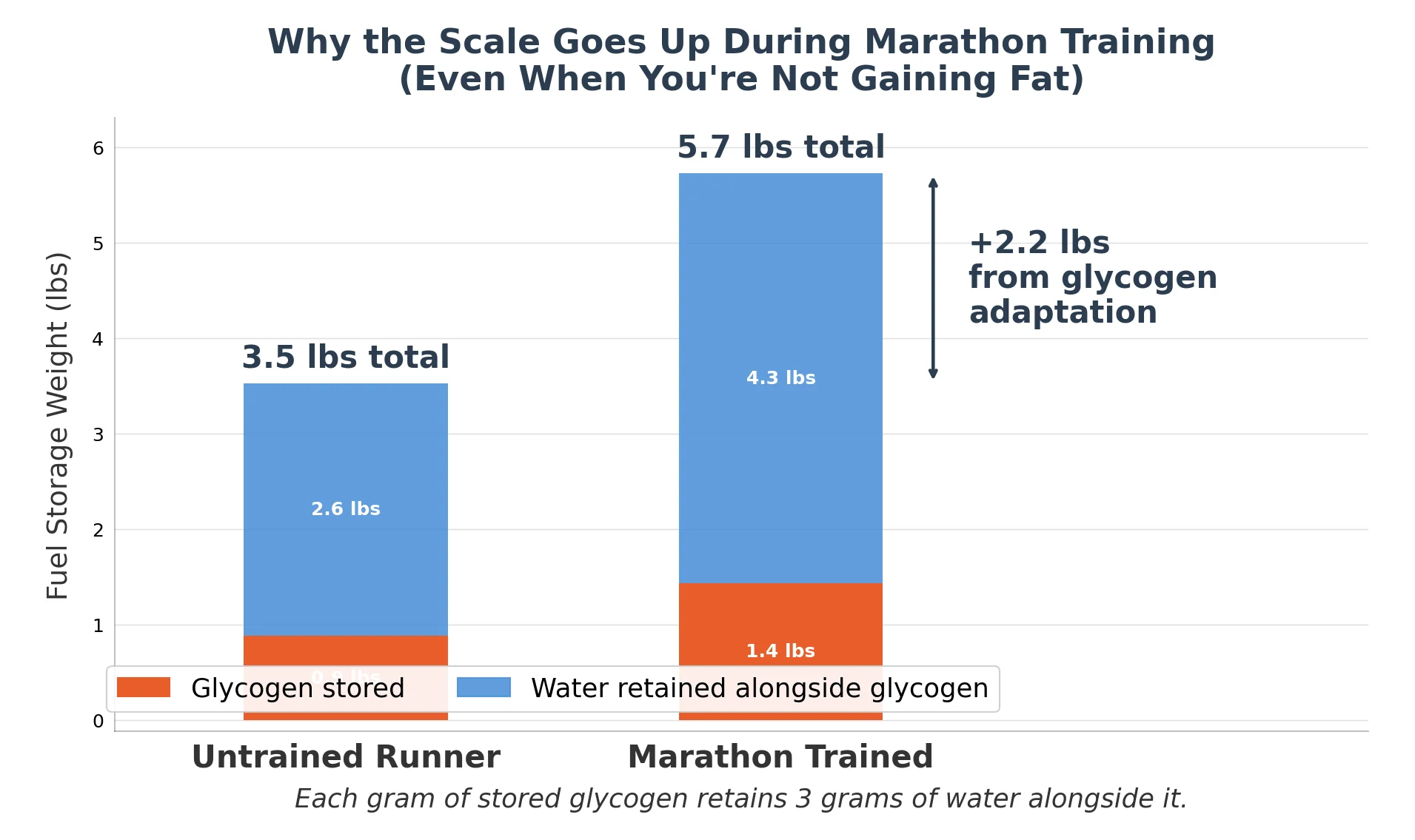
One of many major diversifications of marathon coaching is enhancing your physique’s potential to retailer glycogen, the gas your muscle tissue use throughout lengthy efforts.
According to a review in Sports Medicine, endurance-trained athletes retailer considerably extra glycogen of their muscle tissue in comparison with untrained people, with capability rising 60 to 70% within the early months of a structured coaching program.
Research has shown that muscle glycogen and physique mass are tightly linked: depleting glycogen shops reduces physique weight, and restoring them raises it, as a result of every gram of saved glycogen holds roughly 3 grams of water alongside it.
For each ounce of glycogen saved, your physique additionally shops 3 ounces of water.
That further water reveals up on the dimensions.
Add within the elevated hydration that comes with severe coaching and you’ll simply see a couple of kilos of fluctuation that has nothing to do with fats.
That is truly what you need heading into race day.
Being totally fueled and hydrated means your glycogen shops are topped off and prepared.
Does Your Metabolism Modify When You Eat Extra Throughout Coaching?
Many runners worry that consuming extra throughout heavy coaching blocks will result in weight acquire.
The alternative is normally true.
Your physique adapts to elevated vitality calls for by elevating its metabolic charge.
Feed the system the best gas and it burns hotter.
Including 300 to 500 energy of nutrient-dense meals on arduous exercise days offers your physique the uncooked materials it wants for restoration.
With elevated mileage and more durable periods, your muscle tissue want these energy to restore and adapt.
With out sufficient gas, restoration slows and your physique begins conserving vitality, which is similar metabolic downshift that makes excessive calorie-cutting diets plateau after a couple of weeks.
The important thing distinction: these further energy want to come back from high quality sources, not junk meals.
The metabolic increase works when the gas matches the demand.
What Are the Frequent Publish-Run Diet Errors That Trigger Actual Weight Acquire?
The physiological weight acquire above is innocent.
The actual drawback is when runners overestimate what number of energy they’ve earned.
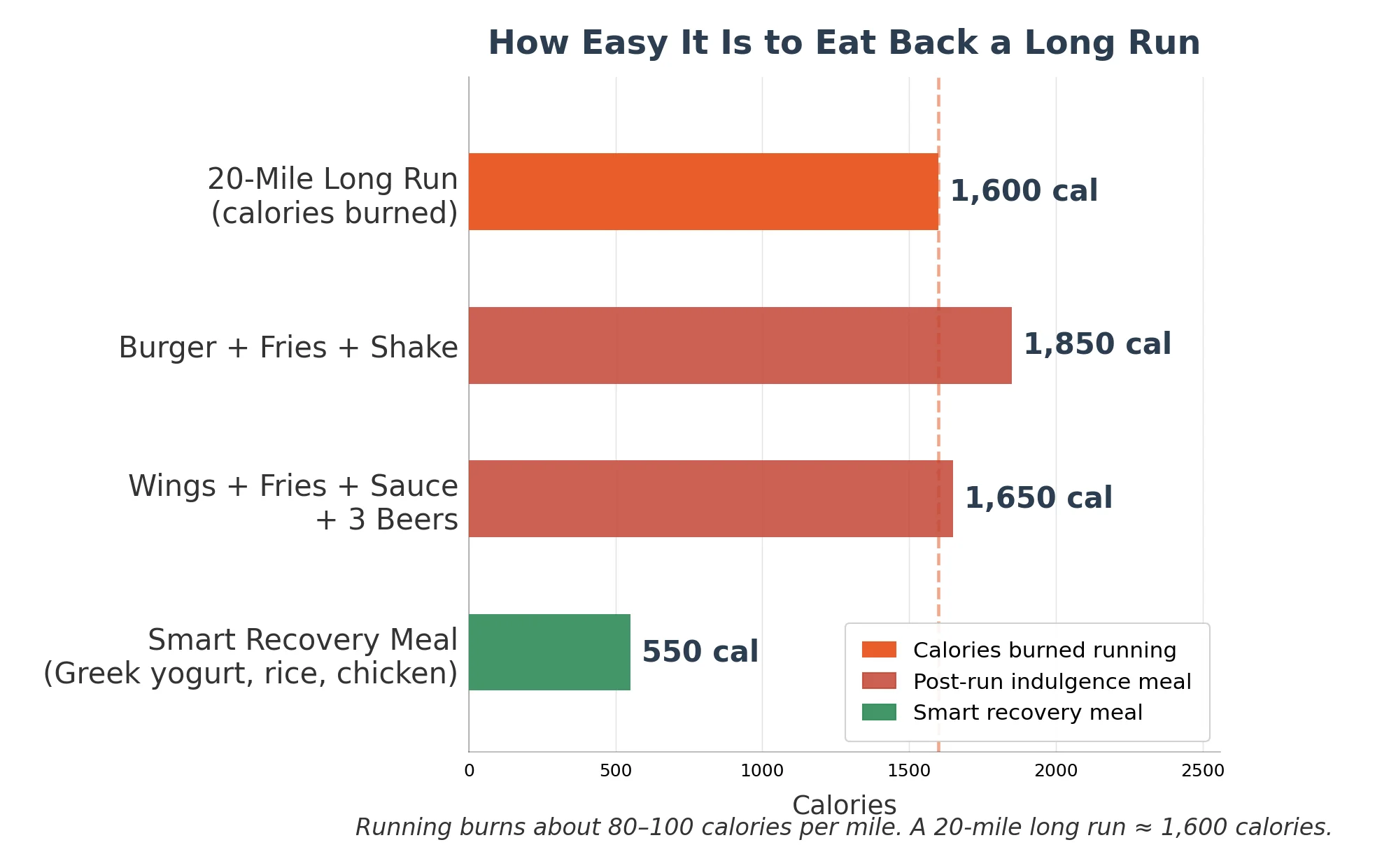
Running burns about 80 to 100 calories per mile, relying in your tempo, weight, and circumstances.
A 20-mile future burns roughly 1,600 energy.
That seems like loads till you do the mathematics on what comes after.
Research has shown that train triggers an implicit longing for high-fat, high-sugar meals, making runners extra probably to decide on calorie-dense meals within the hours after a protracted effort even after they don’t consciously really feel hungry.
How Simple Is It to Overeat After a Lengthy Run?
A basket of wings and fries at a restaurant runs 800 to 1,000 energy.
Add dipping sauce (200 to 300 energy) and three to 4 beers (400 to 500 energy) and also you’re taking a look at 1,400 to 1,800 energy in a single sitting.
That’s your complete caloric value of your 20-miler, worn out with one meal.
In case you fueled through the run with gels or sports activities drinks, you’ve already exceeded what you burned.
The difficulty isn’t indulging often.
It’s the sample of persistently overestimating what coaching earns you.
What Occurs When You Wait Too Lengthy to Eat After a Run?
The opposite lure is the alternative: not consuming quickly sufficient.
After a tough run, some runners cross out on the sofa as an alternative of refueling.
When starvation lastly hits, it hits arduous.
The longer you wait to interchange what was misplaced, the extra your physique craves sugar and fats.
These are the quickest vitality sources, in order that they grow to be irresistible when starvation will get uncontrolled.
Three bowls of cereal and a pint of ice cream later, you’ve undone the calorie deficit with out getting any of the restoration vitamins your muscle tissue truly wanted.
A 2026 meta-analysis found that consuming protein alongside carbohydrates inside 30 to 60 minutes post-run considerably improves muscle restoration and reduces fatigue in subsequent periods.
Eat one thing with protein and carbohydrates inside 30 to 60 minutes after your run, even should you don’t really feel hungry but.
RunnersConnect Bonus
Obtain our FREE restoration meals information, with the highest 10 meals for every of the important restoration nutritional vitamins, minerals and macro vitamins. Plus a pattern 1-day meal plan!
How Do You Know If Marathon Weight Acquire Is Good or Unhealthy?
The size is a blunt instrument.
It could actually’t let you know whether or not the additional kilos are muscle, glycogen, water, or fats.
Higher indicators of what’s truly taking place:
- How your garments match. In the event that they’re the identical or looser, the load is probably going muscle and glycogen.
- The way you look. In case you seem leaner or extra toned regardless of the next quantity, that’s a very good signal.
- Physique fats share, when you have entry to that measurement.
- How your coaching goes. If paces are enhancing and restoration feels strong, the additional weight is gas and health.
Get Your Excellent Weight Calculator
Primarily based in your peak, gender and physique fats, researchers have developed a method to find out what your “excellent working weight is“.
So, with only a few easy inputs, this calculator helps decide your excellent weight and the way a lot over or below this excellent you might be.
If you’re in one of the best marathon-specific form, your physique is carrying topped-off glycogen shops, further hydration, and stronger muscle tissue.
That model of you’ll weigh greater than your untrained, dehydrated, glycogen-depleted self.
Don’t let the dimensions override what the mirror and your coaching log are telling you.
Ought to You Attempt to Lose Weight Throughout Marathon Coaching?
Most often, no.
Marathon coaching and aggressive weight reduction don’t combine effectively.
Chopping energy throughout a high-volume coaching block compromises restoration, will increase damage threat, and limits your physique’s potential to adapt to the coaching stimulus.
If weight reduction is a purpose, the higher strategy is to deal with meals high quality reasonably than restriction.
Select nutrient-dense meals, time your vitamin round exercises, and let the coaching deal with the remainder.
Save sports activities drinks and gels for lengthy runs, arduous exercises, and sizzling climate.
Outdoors of these conditions, they’re simply further energy that don’t meaningfully assist your coaching.
In case you’re not losing weight despite consistent running, the difficulty is nearly all the time in post-run vitamin patterns, not in your mileage.
| Sort of Weight Acquire | Trigger | What to Do |
|---|---|---|
| Muscle mass | Coaching adaptation, stronger legs | Nothing. This improves efficiency. |
| Glycogen + water | Physique shops extra gas as health improves | Nothing. That is race-day readiness. |
| Overcompensation | Consuming extra energy than coaching burns | Observe post-run meals. Deal with high quality over amount. |
| Delayed consuming | Ready too lengthy after runs triggers cravings | Eat protein + carbs inside 30–60 min post-run. |
