


Most runners know they need to heat up earlier than a run, but they don’t really know why.
You’ve in all probability grabbed your sneakers, stepped exterior, and began working at aim tempo inside two minutes.
It felt wonderful on the time, although a bit stiff within the first mile.
However right here’s what you didn’t see: your muscle tissue had been working at a major drawback.
Your muscle fibers had been chilly, stiff, and way more weak to ripping than they’d have been after a correct warm-up.
Your nervous system wasn’t totally activated but, so your stride coordination was barely off.
Your oxygen supply system was enjoying catch-up as an alternative of working at capability.
And relying on the space and depth you deliberate to run, you might need left efficiency on the desk earlier than you even completed your warm-up.
Most runners perceive warm-up as one thing they “ought to do” with out understanding what really occurs of their physique after they do or don’t.
So, on this article you’re going to be taught the research-backed sensible recommendation on:
- What occurs whenever you skip a warm-up and why your muscle tissue change into considerably extra weak to damage
- How your physique prepares itself for working and which physiological adjustments you possibly can speed up
- The best way to match your warm-up to your run kind so that you get the fitting preparation for simple runs, pace work, and race day
What Occurs to Your Muscular tissues When You Skip a Heat-Up?
Your muscle tissue work like springs with temperature-dependent properties.
Once they’re chilly, they’re stiffer and fewer elastic, which adjustments how pressure travels by means of your tissues.
Analysis has proven that the power required to trigger a muscle tear is considerably decrease when muscle tissue are beneath 32°C in comparison with core physique temperature at 37°C.
Research has shown that chilly muscle tissue require considerably much less power to maintain everlasting harm, with the best vulnerability occurring beneath 32°C.
Your peripheral muscle tissue (those in your legs, hips, and shoulders) typically sit on the low 30s and even mid-20s, particularly in cool circumstances.
This temperature hole between your core and your limbs is strictly why chilly muscle tissue tear extra simply.
The second consequence of skipping a warm-up is metabolic lag.
Your cardio methods take a number of minutes to achieve capability, even should you really feel able to run.
And not using a warm-up, your early working minutes are fueled much less effectively, which implies your physique burns by means of power reserves sooner and accumulates fatigue extra shortly.
Your muscle tissue change into considerably extra tear-prone at temperatures beneath 32°C, which is why even a short warm-up issues earlier than exhausting working.
Why Does Your Physique Temperature Matter Extra Than You Suppose?
Muscle temperature is the only most vital issue controlling how your muscle tissue carry out.
If you elevate your muscle temperature by means of gentle jogging, you set off a cascade of physiological adjustments that enhance practically each side of your working.
The primary change is mechanical.
Hotter muscle tissue develop pressure sooner, which implies you possibly can generate energy extra shortly with every stride, and your muscle tissue can loosen up sooner between contractions.
Research has shown that elevated muscle temperature will increase the speed of pressure growth, enhancing muscle contraction pace and total mechanical effectivity.
The second change is chemical.
Oxygen binds extra readily to hemoglobin at hotter temperatures, which means your blood releases oxygen extra effectively to working muscle tissue.
The metabolic enzymes that energy muscle contraction additionally work sooner in hotter tissue.
This mix means your cardio engine fires up extra shortly whenever you begin working exhausting.
RunnersConnect Bonus
Obtain our Energetic Stretching Upkeep Routine
It’s a PDF and video with photographs and descriptions of the best lively stretches for runners.
The third change includes your nervous system.
Nerve conduction velocity (how briskly indicators journey between your mind and your muscle tissue) will increase with temperature.
Because of this your first few strides after a correct warm-up really feel extra coordinated than these first few strides whenever you skip it solely.
Your muscle tissue reply sooner, your timing improves, and your motion sample feels extra environment friendly.
How Lengthy Ought to You Heat Up? It Will depend on Your Run Kind
The perfect warm-up length and depth rely solely on what you’re about to run.
A 20-minute warm-up earlier than a simple 30-minute run is wasteful and can depart you fatigued earlier than the primary effort.
A 5-minute warm-up earlier than a 5K race is inadequate and can depart efficiency on the desk.
The precept is straightforward: match your warm-up depth and length to your run depth.
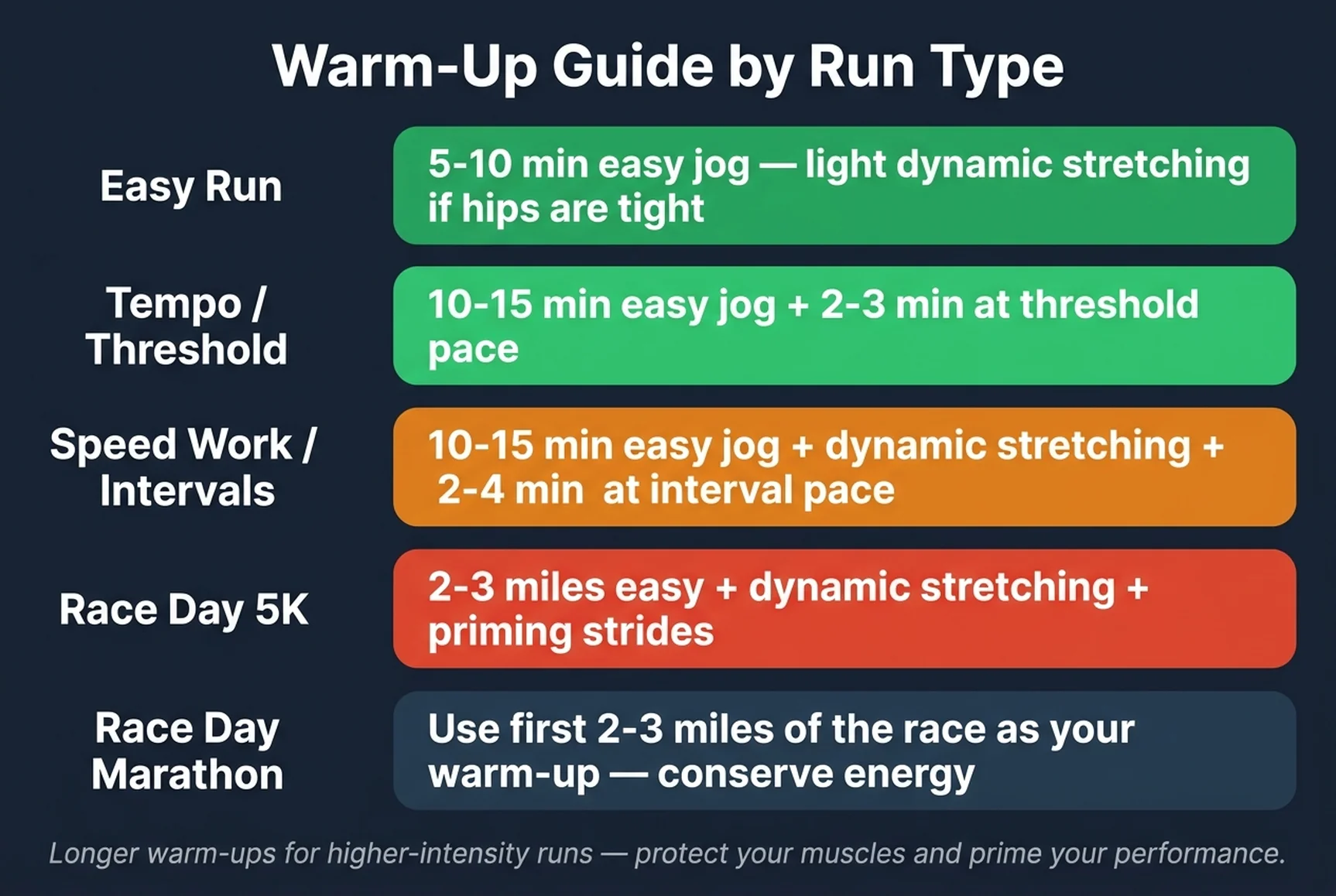
What Ought to You Do Earlier than Simple Runs?
Simple runs type the muse of each runner’s coaching, they usually require minimal warm-up.
5 to 10 minutes of straightforward jogging is ample to lift your muscle temperature and put together your cardio system.
You may embody gentle dynamic stretching in case your hips are tight, however nothing extra is required.
Simple runs want simply 5 to 10 minutes of sunshine jogging to lift muscle temperature with out burning fatigue earlier than the primary effort.
What Ought to You Do Earlier than Tempo and Threshold Runs?
Threshold runs sit on the boundary between straightforward and exhausting, which implies your warm-up wants to arrange you for sustained exhausting effort with out totally exhausting you earlier than the primary set.
Heat up with 10 to fifteen minutes of straightforward jogging, then add 2 to three minutes of working at your threshold tempo.
This priming element tells your cardio system to change into greater gear earlier than you begin your timed effort.
What Ought to You Do Earlier than Velocity Work and Intervals?
Velocity work and interval classes demand probably the most in depth warm-up since you’re asking your muscle tissue to supply pressure at excessive velocity.
Start with 10 to fifteen minutes of straightforward jogging, then add dynamic stretching for the muscle teams you’ll use most.
Comply with that with 2 to 4 minutes of working at or barely sooner than your aim interval tempo.
This graduated strategy raises each your muscle temperature and your nervous system’s readiness with out depleting your glycogen shops.
What Ought to You Do on Race Day?
Race day warm-ups comply with a distance-dependent rule: the shorter the race, the longer your warm-up.
For a 5K, heat up with 2 to three miles of straightforward working, add dynamic stretching, then full your strides utilizing the scientifically recommended warm-up protocol: one 500-meter repetition at 70% effort adopted by three 250-meter repetitions at 100% effort.
For a 10K or half marathon, comply with the identical sample however lengthen the straightforward portion to 2 to three miles you probably have time. For marathon-specific warm-up guidance, the strategy adjustments considerably.
For a marathon, skip the prolonged warm-up solely.
Your aim is to preserve power, so use the primary few miles of the race itself as your warm-up.
You’ll naturally speed up into race tempo as your muscle tissue heat and your cardio system prompts.
On race day, shorter races demand longer warm-ups (2-3 miles for 5K), whereas marathons use the primary few miles because the warm-up itself.
Dynamic Stretching vs. Static Stretching — Which Ought to You Use?
Runners debate stretching within the warm-up greater than nearly some other query, normally as a result of they realized conflicting recommendation from totally different coaches.
Some say “by no means static stretch earlier than a run” whereas others swear by holding a 30-second hamstring stretch.
The analysis clarifies the confusion.
Dynamic stretching (transferring your limbs by means of a variety of movement whereas warming up, akin to leg swings or strolling lunges) improves working economic system considerably greater than static stretching.
Static stretching, the place you maintain a stretch for 30 seconds or extra, doesn’t impair working efficiency the best way some coaches declare, but it surely gives much less quick profit than dynamic work.
The sensible takeaway is simple: use dynamic stretching in your pre-run warm-up and save static stretching for after your run when your muscle tissue are heat.
Use dynamic stretching earlier than your run and save 30-second static holds for afterward, when your muscle tissue are already heat.
RunnersConnect Bonus
Obtain our Energetic Stretching Upkeep Routine
It’s a PDF and video with photographs and descriptions of the best lively stretches for runners.
The Frequent Heat-Up Errors Runners Make
Even runners who perceive warm-up worth typically shortcut the method in ways in which undermine the advantages.
The commonest mistake is skipping the warm-up solely, normally on account of time constraints or poor planning.
The second mistake is matching your warm-up depth to the mistaken run kind, akin to doing a 15-minute warm-up earlier than a simple run and arriving on the principal effort already fatigued.
The third mistake is static stretching when you ought to be doing dynamic work.
This misunderstanding normally comes from studying to stretch in yoga or health lessons, the place static stretching is suitable, however warm-up stretching serves a special function.
The fourth mistake is underestimating race-day warm-ups, significantly for shorter distances like 5K.
Many runners arrive at a race considering a fast 10-minute warm-up is ample, then watch runners round them full full warm-ups with priming repetitions and marvel why they really feel flat on the beginning line.
The underside line is that this: your warm-up is just not a luxurious or an afterthought.
It’s the bridge between your resting state and your working state, and it instantly determines how protected and the way environment friendly your muscle tissue are for the subsequent hour.
A five-minute warm-up raises your muscle temperature, prepares your nervous system, and reduces your damage threat.
A well-designed warm-up that matches your run depth unlocks efficiency you couldn’t entry some other method.
Subsequent time you’re tempted to skip it or rush by means of it, keep in mind that runners who take warm-up severely don’t simply keep away from damage: they run sooner, extra effectively, and with higher type proper from the primary stride.
